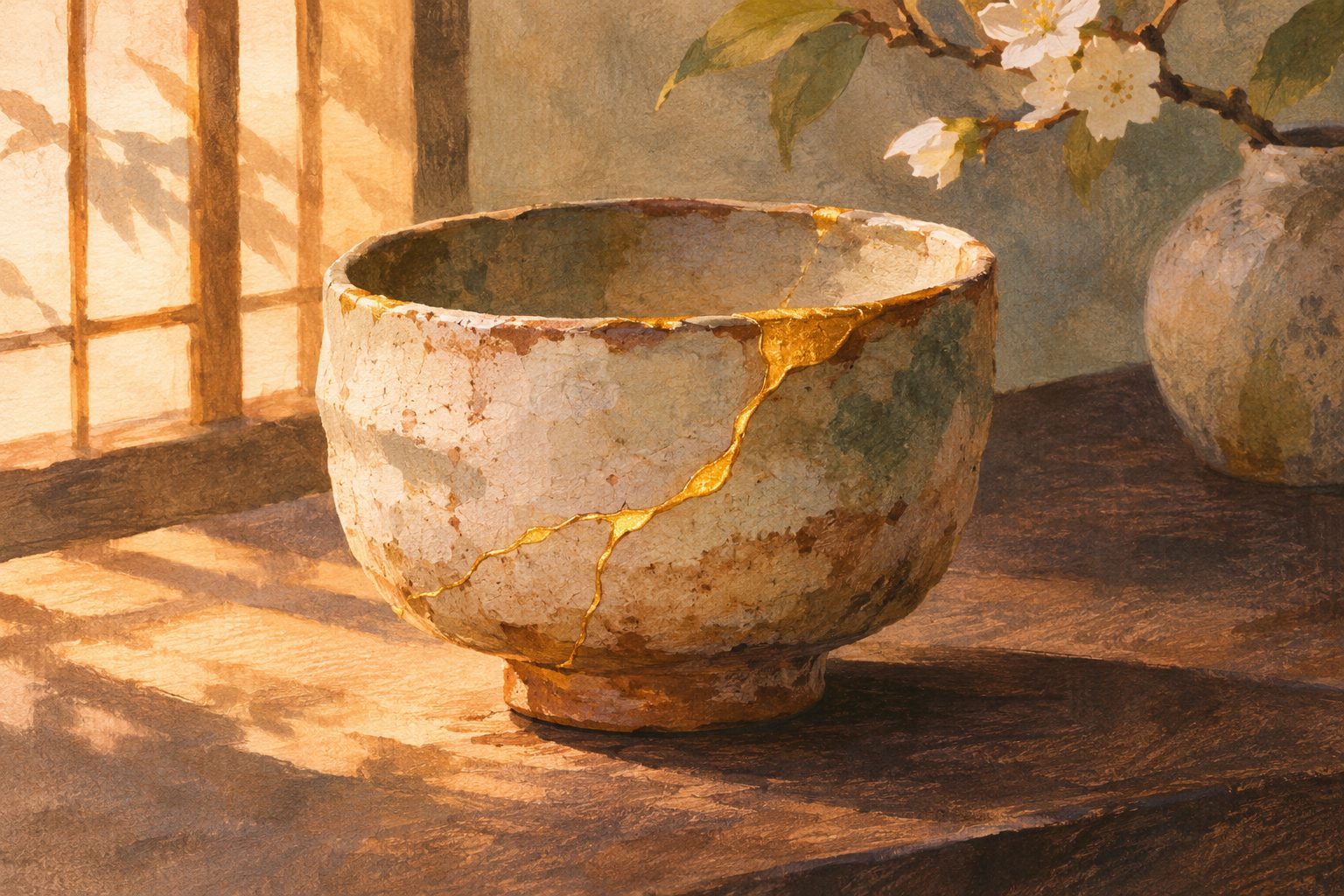
A scroll through any English-language design feed will reveal the same word taped onto everything: a chipped mug is "wabi-sabi," a cracked wall is "wabi-sabi," an asymmetrical shelf is "wabi-sabi." The word has become a decorative label for anything imperfect. Yet when a broken bowl is repaired with gold, the same feeds call that kintsugi—and treat the two words as if they were synonyms. They are not. Wabi-sabi is a way of seeing the world; kintsugi is a craft practiced with lacquer and gold. They overlap, but they are not the same thing, and the difference matters.
This essay sets the two ideas side by side: where wabi-sabi comes from, what kintsugi actually is, and where the two meet and part. The confusion is understandable—both emerged from the same soil of Japanese aesthetics—but untangling them reveals something richer than a decorating trend.
I. Wabi-Sabi: The Aesthetic of Less (侘寂:引き算の美学)
Wabi-sabi (侘寂) joins two words with long histories. Wabi originally meant the loneliness of living in nature, away from society; by the fifteenth century it had become an aesthetic of rustic, austere beauty—the kind found in a simple tea room with earthen walls and a single flower. Sabi refers to the beauty that comes with age, wear, and the passage of time: the patina on a bronze bell, the moss on a stone lantern, the darkening of a wooden floor where feet have walked for generations.
Together they describe a way of finding beauty in what is imperfect, impermanent, and incomplete. The poet Matsuo Bashō, the tea master Sen no Rikyū (1522–1591), and the Zen monks who shaped Japanese culture all moved within this sensibility. It was never a rule book. It was a temperament—a preference for the quiet, the weathered, and the understated over the flashy, the new, and the perfect.
Crucially, wabi-sabi is not a decorating style. It cannot be purchased at a store or applied with a paintbrush. A room can be styled to look wabi-sabi—rough plaster, muted colors, asymmetrical arrangement—but the aesthetic lives in the eye of the beholder, not in the objects themselves. As Leonard Koren wrote in his 1994 book that introduced the concept to the West, wabi-sabi is "a beauty of things imperfect, impermanent, and incomplete." It is a perspective, not a product.
II. Kintsugi: The Craft of Golden Repair (金継ぎ:金色の継ぎ目)
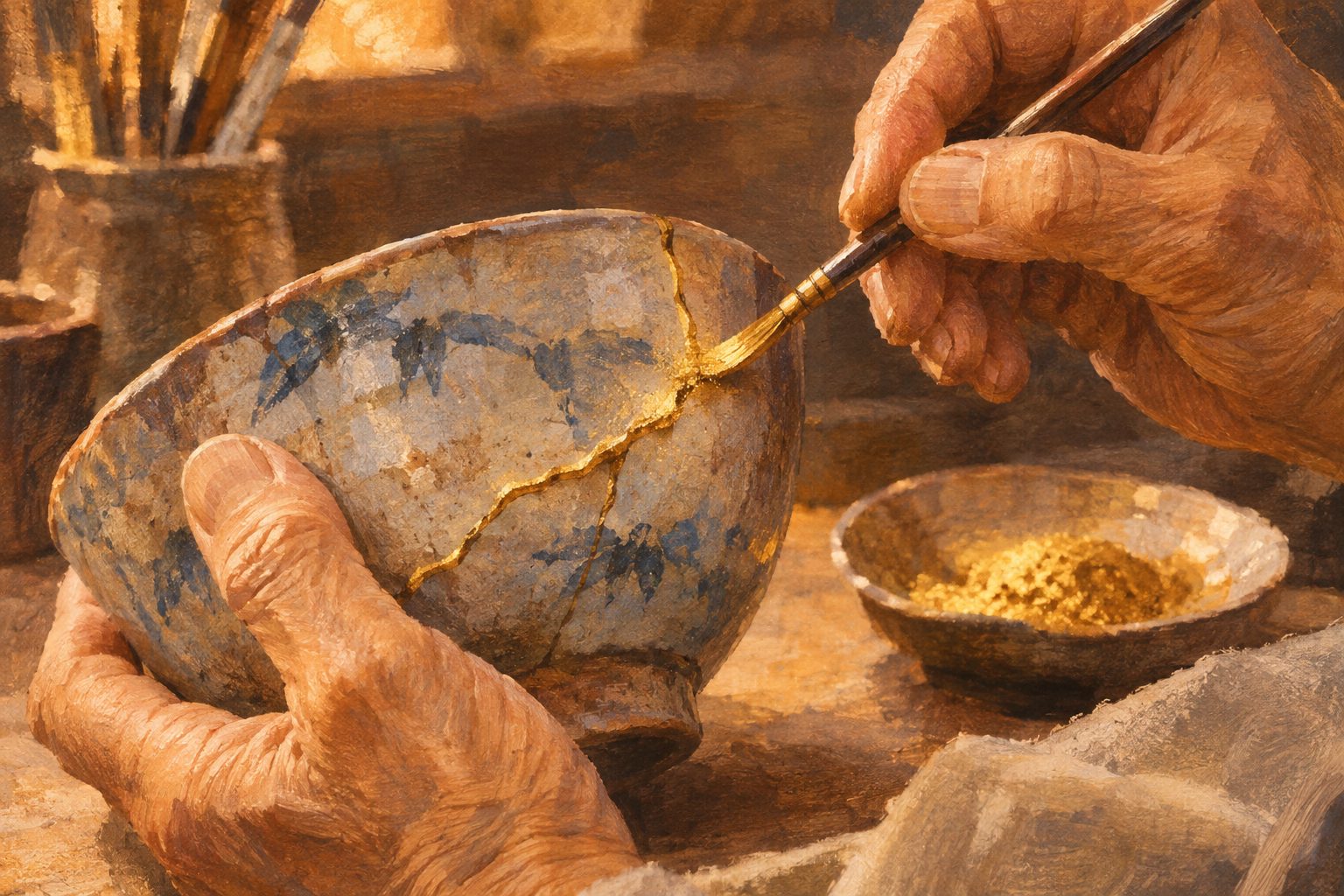
Kintsugi (金継ぎ), literally "golden joinery," is a specific craft: the repair of broken pottery using urushi lacquer—the sap of the lacquer tree—mixed with or dusted with powdered gold, silver, or platinum. The process is slow. The artisan cleans the broken edges, fits the pieces together, applies lacquer, and places the bowl in a warm, humid wooden cabinet (muro) to cure for weeks. Multiple layers of lacquer are applied, each cured before the next. Only at the end does the artisan trace the raised seam with gold.
The most famous origin story is told rather than documented: the fifteenth-century shogun Ashikaga Yoshimasa sent a cracked Chinese tea bowl to China for repair, and it came back fastened with ugly iron staples. Japanese craftspeople, the story goes, set out to mend such bowls more beautifully. Whether or not that exchange happened as recorded, the technique it describes is real, and it has been practiced in Japan for over five centuries.
What makes kintsugi distinctive is its philosophy of repair: the break is not hidden but highlighted. The golden seam becomes part of the object's history—a visible record of what the bowl has survived. This philosophy is often linked to wabi-sabi, and the connection is genuine: both value the marks of time and use. But kintsugi is a craft, with tools, materials, and a specific technique. It is something a person does with their hands.

III. Where They Meet, Where They Part (交わるところ、分かれるところ)
The two ideas overlap at one important point: kintsugi can be appreciated through a wabi-sabi lens. A repaired bowl that shows its cracks in gold embodies the wabi-sabi acceptance of imperfection—the object is not restored to an imagined state of untouched perfection; its history is preserved and even celebrated.
But the overlap should not be mistaken for identity. Consider three distinctions:
Gold is not austere. Wabi-sabi, in its narrow sense, values the humble and the restrained—a plain clay bowl, a weathered wooden gate. A golden seam is brilliant, even luxurious. It does not fit the strictest definition of wabi. Kintsugi can be beautiful in a wabi-sabi way, but it is not itself wabi-sabi.
Most wabi-sabi objects are not kintsugi. A moss garden, a rusted iron gate, a faded indigo cloth, a ceramic bowl left unrepaired—these are all wabi-sabi without any golden repair. Wabi-sabi is the larger container; kintsugi is one particular thing inside it.
Most kintsugi repairs are not "wabi-sabi objects." A bowl repaired with gold and displayed in a museum case is a work of craft, appreciated for its technique and its story, not necessarily for its adherence to any aesthetic principle. The craft stands on its own.
IV. What This Means for Us (私たちの暮らしの中で)
The practical difference between the two ideas is simple. Wabi-sabi says: do not throw away the chipped mug; learn to see beauty in its chip. Kintsugi says: take the broken bowl, and repair it with gold so the repair becomes part of its story. One is an attitude; the other is an action.
Both teach the same underlying lesson: the "flaw" carries history worth keeping. In a culture that treats every scratch as a defect to be hidden, both ideas offer a gentler alternative. The chip in your grandmother's teacup is not a failure—it is a record of every morning she held it. The crack in your confidence after a difficult season is not something to conceal; it is evidence that you carried something heavy and did not break.
This is the territory explored in Kintsugi of the Soul, where the golden repair becomes a metaphor for human resilience. And it connects to the quiet depth of yūgen—the beauty that lies in what remains unsaid—and to Sen no Rikyū's art of subtraction, where removing the unnecessary reveals what matters.
Next time you see a chipped bowl or a weathered wall, pause before labeling it. Ask: is this a way of seeing, or a thing made by hand? The answer will not change the object. But it might change how you look at everything else.
The golden seam does not hide the break. It remembers it.