I. The Tree on the Sea Wall (潮風を受け流す海辺の黒松)
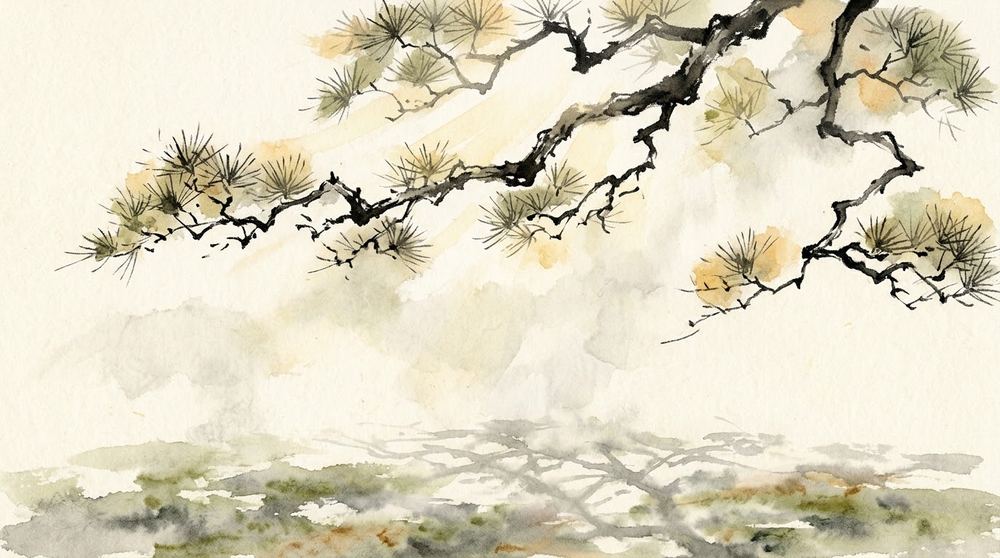
Along the rocky coastlines of the Sea of Japan and the Seto Inland Sea, Japanese black pines ( kuromatsu ) grow in places where no sensible tree would choose to take root. Anchored in thin pockets of gravel wedged between granite boulders, they lean out over the salt spray at improbable angles. Their trunks are knotted and low; their bark is plated like dark iron. Yet year after year, when late-summer typhoons sweep across the archipelago and snap thick, well-watered boulevard trees inland, the cliff pines remain standing.
If you stand beneath one of these coastal pines on a windy afternoon, you quickly notice why. A tree grown in rich valley soil often develops a dense, heavy crown of foliage that acts like a canvas sail; when a gale hits, the canopy catches the full force of the wind until the trunk or roots give way. The cliff pine, shaped by salt and scarcity, has wide, airy gaps between its boughs. It survives the storm not by opposing the wind with a thicker wall of needles, but by allowing the gale to pass straight through its crown.
II. What the Gardeners Read in the Mountain Pines (『作庭記』と庭師の「透かし剪定」)
Nearly a thousand years ago, during the late Heian period, an aristocratic builder—traditionally identified as Tachibana no Toshitsuna—compiled the Sakuteiki (Records of Garden Making), the oldest surviving treatise on Japanese garden design. Rather than inventing geometric shapes to impose upon nature, the Sakuteiki instructs the maker of gardens to study how rocks, water, and wind-bent trees actually endure in the wild, and then capture their inner principle ( fuzei ).
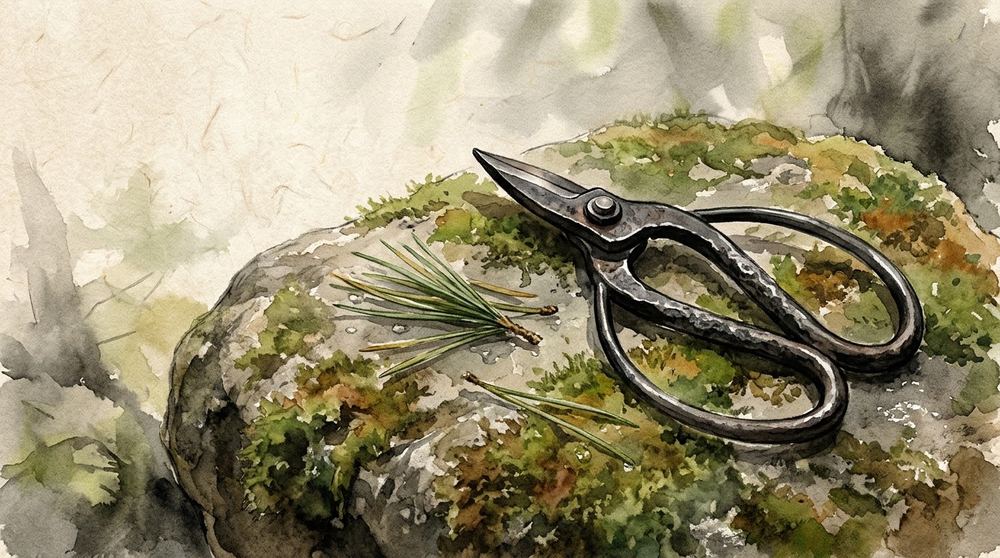
Centuries of Japanese gardeners ( niwashi ) observed the coastal and mountain pines and translated their survival mechanism into a specialized horticultural discipline known as sukashi-sentei —literally, "thinning" or "see-through pruning." Walk into a temple garden in Kyoto in late autumn and you will see gardeners perched high on three-legged bamboo ladders, working in near-total silence. They are not shearing the outside of the pine into a tight, decorative ball the way Western topiary is clipped. Instead, they reach deep inside the branches with forged iron shears ( warabi-basami ) and pluck excess shoots by hand ( momiage ), removing crossing twigs, inward-growing needles, and crowded secondary boughs.
III. Creating Space for Wind and Winter Snow (風と雪の通り道をつくるという守り方)
To an untrained eye, a gardener practicing sukashi-sentei seems to be taking away the tree’s fullness. By the end of the day, a surprising pile of healthy green branches lies on the moss below, and the pine’s silhouette looks lighter, almost sparse. Yet the gardener is performing two vital acts of protection.
First, by opening channels through the interior of the canopy, the gardener ensures that when winter blizzards arrive with heavy, wet snow, the flakes will not accumulate into a crushing roof that snaps the boughs. Second, when the spring winds and summer typhoons return, the gusts flow cleanly between the layered branches without wrenching the trunk. Light and air reach the innermost bark, preventing rot and allowing the remaining branches to thicken with quiet, unhurried vigor. A tree that refuses to part with any of its shoots eventually chokes its own center and breaks under the first heavy season.
IV. The Overgrown Canopy of Modern Adulthood (枝葉を茂らせすぎた現代の暮らし)
Most of us were raised on an additive definition of strength. We are taught that a capable adult is someone who can carry more: another project at work, another committee, another obligation, another stream of daily news and messages. When we feel strained, our instinct is to brace our shoulders and try to thicken our trunk—to sleep a little less, drink another cup of coffee, and hold the entire dense canopy of our commitments intact.
Look closely at someone approaching exhaustion, however, and you will see the exact anatomy of an unpruned tree before a storm. Every hour of their week is so tightly packed with overlapping twigs—urgent emails, social expectations, self-imposed standards, old habits they have outgrown but feel guilty dropping—that there is nowhere for an unexpected gust to go. When a child falls ill, a client changes a deadline, or a small household appliance breaks, that minor wind hits a solid wall of zero margin. What breaks us is rarely the weight of our core life; it is the surface area of everything we refused to thin out.
V. Picking Up the Shears in Our Own Days (自分の日々に鋏を入れる勇気)
Practicing sukashi-sentei in a human life requires a different kind of courage than endurance. Anyone can say yes to a new leaf; it takes a steady hand to look at three good, respectable commitments and snip two of them away at the base so that the third can actually breathe.
In practical terms, this means leaving visible gaps between the boughs of our day. It means declining a project not because we are incapable of doing it, but because keeping it would close the airway around the work and the people we care about most. It means noticing the "inward-growing branches" of the mind—the obligations we maintain solely out of fear of disappointing others—and cutting them cleanly rather than letting them tangle in the dark. Resilience has never been the ability to catch every wind that blows and stand rigid against it. True strength looks like the pine on the sea wall: rooted in stone, pruned to essentials, with enough open sky between its branches that the storm can pass through without finding anything to tear away.