I. The Garden With No Flowers Left (花がひとつもない庭の驚き)
In the sixteenth century, word reached the regent Toyotomi Hideyoshi that the fences of Sen no Rikyū’s garden were covered in an extraordinary profusion of morning glories ( asagao )—then a rare and prized botanical wonder in Japan. Eager to behold a sea of blossoms at their peak, Hideyoshi announced that he would visit Rikyū’s residence for a morning tea gathering.
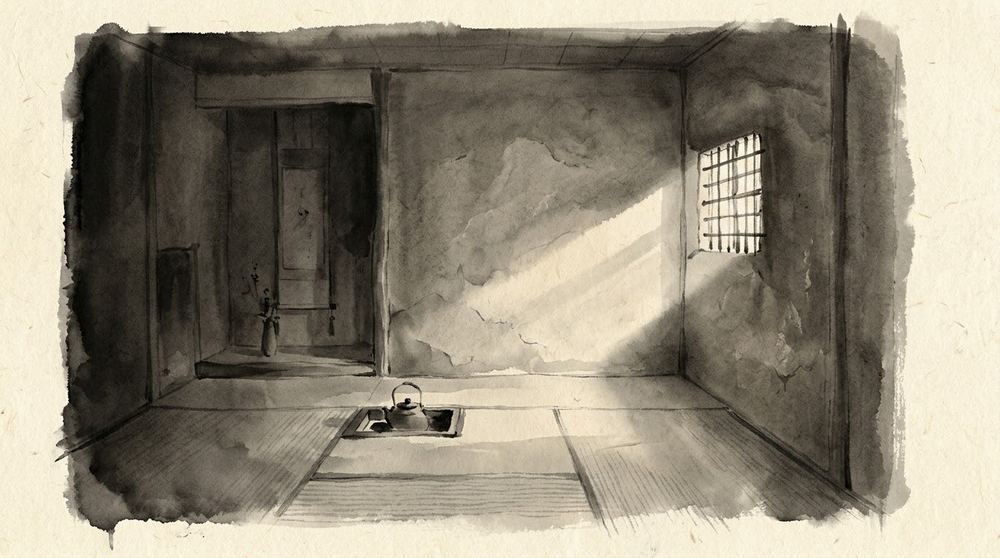
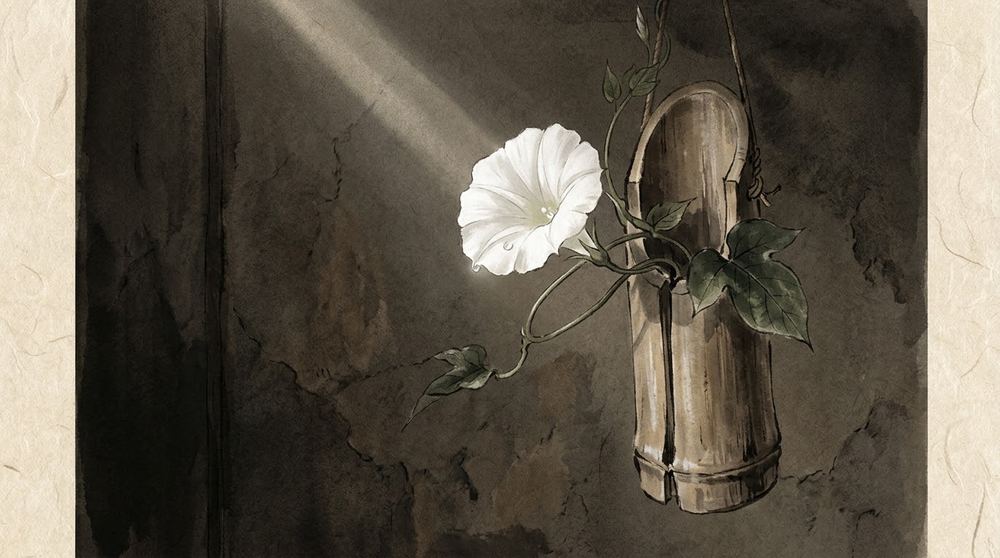
When Hideyoshi arrived at dawn and walked along the dewy stepping-stone path ( roji ) toward the tea hut, he stopped in astonishment and irritation. Every single morning glory blossom along the garden fence had been cut away. Not a petal remained—only swept earth and trimmed green vines. Concealing his displeasure, Hideyoshi bent low to crawl through the small square entrance ( nijiriguchi ) into the darkened tea room. There, in the dim alcove ( tokonoma ), illuminated by a single narrow shaft of morning light from the lattice window, stood one white morning glory with a drop of dew still trembling on its rim, arranged in an old bronze vessel.
As preserved in traditional tea chronicles ( chadō denshō ), Hideyoshi was left speechless. Had Rikyū left five hundred flowers outside in the sun, the regent would have admired them for ten seconds as a spectacle and forgotten them by noon. By cutting away four hundred and ninety-nine blossoms, Rikyū gathered the entire life force of the summer morning into a single focal point.
II. Why Perfectionists Always Add Instead of Cut (なぜ完璧主義の人は「足し算」ばかりしてしまうのか)
When people talk about Rikyū and the aesthetic of wabi, they often drift into sentimental praise of rough teacups or weathered wood. Yet Rikyū’s most radical gesture was not romanticizing age; it was his ruthless, surgical willingness to subtract ( hikizan no bigaku —the aesthetics of subtraction).
For anyone who struggles with perfectionism in modern work or daily life, Rikyū’s garden shears offer a much-needed mirror. When we are anxious about whether our work is good enough, our nearly universal instinct is to add. Writing a presentation for an important client, we add five more slides of backup data so no one can accuse us of being unprepared. Designing a room or a website, we fill every empty corner with another feature. Planning a weekend for our family, we pack the schedule from eight in the morning until eight at night.
We think this accumulation is thoroughness. In reality, it is often a polite form of fear. Keep all five hundred morning glories on the fence, and you never have to take responsibility for choosing which one truly matters. By crowding the frame with everything we know, we hide behind volume—and leave the person on the other side of the table exhausted before they have even begun.
III. The Architecture of the Two-Mat Room (二畳の茶室と、暗さがつくる光)
Rikyū applied this same discipline of subtraction to the physical space of the tea room itself. While aristocrats of the Momoyama period competed to build vast recepción halls ( shoin ) gleaming with gold leaf andimported Chinese porcelain, Rikyū shrank the tea room down to the Tai-an —a space of just two tatami mats, roughly six feet square, with rough earthen walls mixed with straw.
Outside the entrance, the roji garden path was designed not to impress the visitor with exotic plants, but to strip away the dust of the world ( chiri ) step by step before one entered the hut. The low entrance forced even a warlord to unbuckle his long sword and leave it on the rack outside. Rikyū understood a psychological law that modern productivity culture still resists: human attention is not infinite. You cannot experience depth in a room where twenty objects are shouting for your eye at the same time. Light only becomes luminous when you allow the surrounding walls to remain dark.
IV. Practicing the Morning Glory Cut in Daily Work (日常の机の上で「四百九十九輪」を切る)
What would happen if we brought Rikyū’s shears to our own desks and homes this week? Practicing the art of subtraction does not mean living in a bare cell; it means having the courage to protect the single morning glory in each part of our day by clearing away the four hundred and ninety-nine distractions competing with it.
In practical work, the "morning glory cut" looks like this:
- In a presentation or memo: After drafting everything you want to say, ask yourself which single sentence or insight you want your listener to remember tomorrow morning. Then cut every slide, paragraph, or tangent that merely flatters your own effort without serving that center.
- On your daily task list: Instead of writing down twelve "priorities"—which is a contradiction in terms—choose the one task that carries the true weight of the day, and clear the desk of every other tab and document until that one piece is finished.
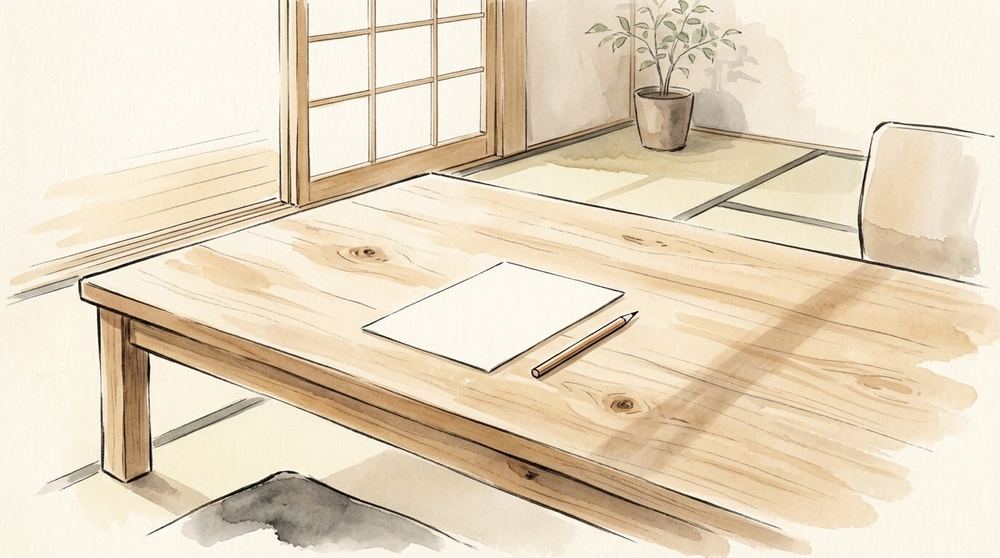
- In your living space: Look at the table or shelf you see first when you wake up. Remove three objects that are sitting there only out of habit, leaving one thing you genuinely love with enough empty wood around it to breathe.
Perfectionism tells us that we will finally feel safe when we have included everything. Rikyū’s quiet alcove reminds us of the opposite: a work, a room, or a day becomes unforgettable not when there is nothing left to add, but when we have finally mustered the calm courage to cut away everything that was only noise.