I. Why Mental Exhaustion Wears More Than One Face (「考えすぎ」には三つの異なる結び目がある)
When we say we have been thinking too much, we usually speak as though mental fatigue were a single illness with a single cure. We tell ourselves to take a walk, breathe deeply, or simply stop worrying. Yet anyone who has lain awake at two o’clock in the morning knows that a restless mind is rarely calmed by a generic instruction, because the mind tangles itself in several completely different ways.
On some evenings, our exhaustion is mechanical: we have spent all day solving complex problems at work, and even after we sit down at the dinner table, our brain refuses to switch off the problem-solving machinery. On other evenings, our exhaustion is interpersonal: a brusque three-word email from a colleague or a careless remark from a neighbor echoes in our ears, and we spend hours constructing a courtroom drama about why they disrespected us. And on still other nights, our exhaustion is speculative: we look out at an uncertain economy, a changing workplace, or a family transition, and we argue endlessly in our heads over every external detail while forgetting to check the state of the person doing the watching.
Across the classical traditions of India, China, and Japan, the elders noticed that these three habits of mind require entirely different remedies. Rather than offering a single slogan, they left behind distinct parables—each built around a concrete physical object. Placed side by side, the stories of the Raft, the Empty Boat, and the Temple Banner act as a diagnostic mirror, helping us see what kind of knot our mind has tied today and which hand movement will loosen it.
II. The Raft on the Dry Road (乾いた山道で背負い続ける「筏」)
In the Alagaddūpama Sutta (Majjhima Nikāya 22 of the Pāli Canon), the Buddha describes a traveler who comes to a wide, dangerous stretch of water. The near bank is unsafe and full of brambles; the far bank is secure, yet there is no ferryboat and no bridge. Using his own resourcefulness, the traveler gathers dry reeds, branches, and vines, lashes them together into a serviceable raft, and paddles across with his hands and feet until he reaches the safety of the other side.
Once he stands on firm, dry ground, however, the traveler faces a peculiar temptation. Looking down at the craft that saved him, he thinks: This raft has been extraordinarily useful to me. It carried me across the current when nothing else could. Instead of leaving it behind, I should hoist it onto my head or strap it across my shoulders and carry it with me wherever I go.
Anyone watching a man trudge up a steep mountain footpath under the crushing weight of waterlogged timber and wet vines would see the mistake immediately. The raft was indispensable in the river; on the forest trail, it is only a burden. The discourse concludes that a wise traveler neither despises the raft nor clings to it, but moors it gently at the shoreline—or sets it on the bank—and walks on with unencumbered hands.
This first parable diagnoses the overthinking of the unretired tool. Analytical thinking, contingency planning, and hyper-vigilance are wonderful rafts when we are actually in the middle of a difficult crossing—managing a tight deadline, navigating a medical decision, or resolving a logistical crisis. We suffer when our feet have already touched dry land at six o’clock in the evening, yet we insist on carrying the analytical framework into our living room. The remedy here is not to distrust your intellect, but to recognize that a plan is a vehicle for a specific crossing, not a permanent piece of clothing.

III. The Empty Skiff in the River Mist (霧の川から流れてくる「虚舟」)
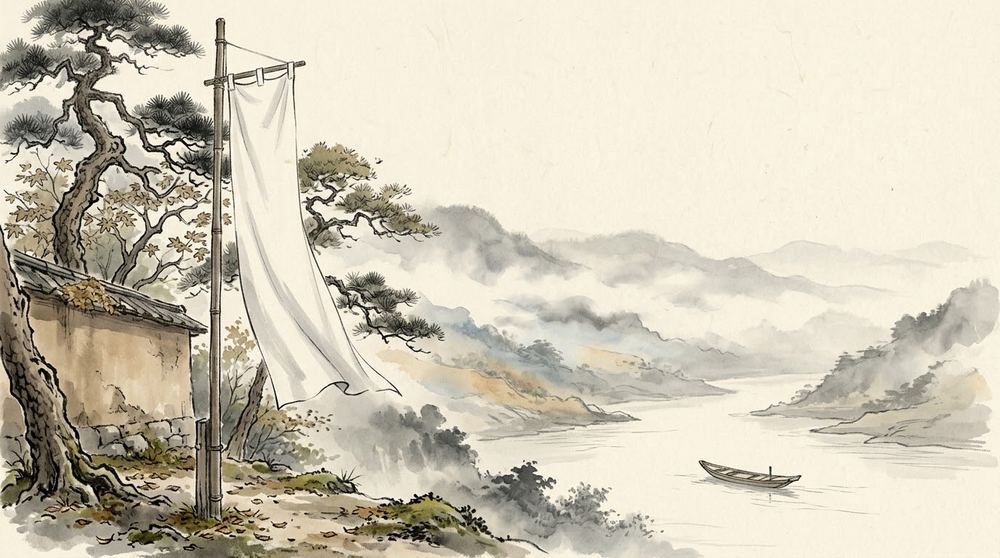
A second, wholly different mechanism of overthinking appears in Chapter 20 ( Shanmu / "The Mountain Tree") of the classical Daoist text Zhuangzi. Imagine, Zhuangzi says, that you are crossing a misty river in a small wooden boat, and suddenly another skiff comes drifting out of the fog and bumps hard against the side of your hull.
If you look over the gunwale and see a boatman sitting in that other craft, your mind instantly ignites. You shout at him to watch where he is steering. If he does not answer, you shout louder; by the third call, you are ready to unleash a torrent of curses, convinced that the man is either arrogant, reckless, or deliberately trying to ruin your morning. Your heart pounds, and you rehearse the insult for the rest of the day.
Now suppose, Zhuangzi continues, that you look over the side at the exact moment of impact and discover that the other boat is completely empty—an unmoored hull ( kyoshū / 虚舟) that broke loose from its rope upstream and is simply drifting with the current. In a single heartbeat, your fury evaporates. The physical bump against your planks was identical in both cases, yet because there is no person inside the other boat to receive your blame, your mind does not bother to manufacture a story of malice.
Zhuangzi’s empty boat exposes the overthinking of invented intent. Half the mental rehearsals that keep us awake at night are not caused by the bump itself; they are caused by our insistence on placing an imaginary villain at the helm of every inconvenience. When a partner speaks shortly at breakfast or a friend forgets to return a call, our anxious mind immediately assumes a deliberate slight toward us. More often than not, the other person’s boat is simply unmoored by their own exhaustion, distraction, or private worry. Recognizing the empty boat does not mean excusing genuine harm; it means refusing to spend three hours arguing with a shadow when nobody was aiming at you in the first place.
IV. The Wind and the Temple Banner (境内に揺れる「風と幡」)
Our third lens comes from the Platform Sutra of the Sixth Patriarch ( Rokusodangyō ) and is preserved as Case 29 of the thirteenth-century Zen collection Mumonkan (The Gateless Barrier). Upon arriving at Faxing Temple in Guangzhou after years of obscurity, theSixth Patriarch Huineng (638–713) overheard two monks standing in the courtyard beneath a tall cloth temple banner ( hata ) that was snapping and rippling in the afternoon breeze.
The first monk pointed upward and declared that the banner was moving; without the cloth, nothing would be seen. The second monk disagreed, arguing that the wind was moving; without the wind, the cloth would hang dead against the pole. Back and forth they went, each marshaling sharper logic to prove which external factor was the true cause of the motion, their voices rising as neither could settle the question.
Stepping forward from the edge of the courtyard, Huineng interrupted their debate with a quiet observation: It is neither the wind that moves, nor the banner that moves; honorable sirs, it is your own mind that moves. Struck silent, the two monks realized that while the cloth and the breeze were simply doing what cloth and breeze have done since the beginning of time, the restless agitation they felt belonged entirely to their own craving to pin down and argue over the scene.
Huineng’s banner illuminates the overthinking of misplaced location. When we are overtired or anxious, we often convince ourselves that we are conducting an urgent, objective debate about the outside world—whether the market is shifting, whether a project’s timeline is fair, whether the weather or the city has become too noisy. Like the two monks in the courtyard, we trade endless arguments with ourselves over the wind and the cloth. Huineng’s remedy is a sudden shift of camera angle: stop staring at the banner for a moment, and notice the tremor in the observer. Often, the outside problem looks unsolvable only because the mind looking at it is hungry, sleep-deprived, or afraid.
V. Naming Which Knot You Are Holding Tonight (今夜、自分の手が触れているものを確かめる)
When your thoughts begin to circle tonight, resist the urge to scold yourself for thinking. Instead, treat those three ancient scenes as a quiet diagnostic checklist to see what your mind is actually doing.
If you are still mentally editing a spreadsheet or rehearsing a project checklist long after you have closed your laptop for the day, you are carrying the raft on dry land. Thank the raft for getting you across the workday, set it down on the hallway shelf, and walk into your evening with empty hands.
If you are replaying a brusque comment or a delayed reply and building a case about why someone does not respect you, look inside the drifting boat. Ask whether the other person was truly steering toward you with malice, or whether you were simply bumped by the unmoored hull of someone else’s busy, imperfect day.
And if you find yourself debating ten hypothetical futures at midnight—arguing with yourself over whether the wind or the flag is to blame—step back into Huineng’s courtyard. Leave the banner to the breeze, pour a cup of warm water, and rest the mind that was doing all the moving.