Shoshin and the Cost of Knowing: When Expertise Closes the Mind
Exploring shoshin beginner's mind philosophy reveals that our greatest obstacle to clarity is rarely ignorance; it is the quiet armor of believing we already know. Preserved in the tenth-century Zen chronicle Transmission of the Lamp ( Jingde Chuandeng Lu ) and the fifteenth-century Noh treatise Kakyō by Zeami Motokiyo, Eastern tradition warns that accumulated knowledge easily hardens into a heavy stone carried inside the chest, dulling our attention to the living moment.
I. The Heavy Stone on the Rainy Road (雨の日の山門と、頭の中の重たい石)
In the tenth century, a young monk named Fayan Wenyi (法眼文益) set out on pilgrimage across southern China with two companions. Fayan was no ordinary novice. He had spent years mastering the Buddhist canon, memorizing commentaries, and debating subtle doctrines of mind and nature. He walked with the quiet confidence of a scholar who had an answer prepared for every question.
As autumn rain turned the mountain roads to mud, the three travelers sought shelter at Jizo Hermitage, where the old master Luoan Guichen (羅漢桂琛) lived. While the rain drummed against the eaves and soaked the courtyard stones, Guichen sat by the brazier and asked Fayan where he was bound.
"I am wandering on pilgrimage," Fayan replied.
"Why do you wander?" the old master asked.
"I do not know," Fayan answered, offering what he believed was a sophisticated philosophical reply.
Guichen looked at him calmly. "Not knowing is most intimate."
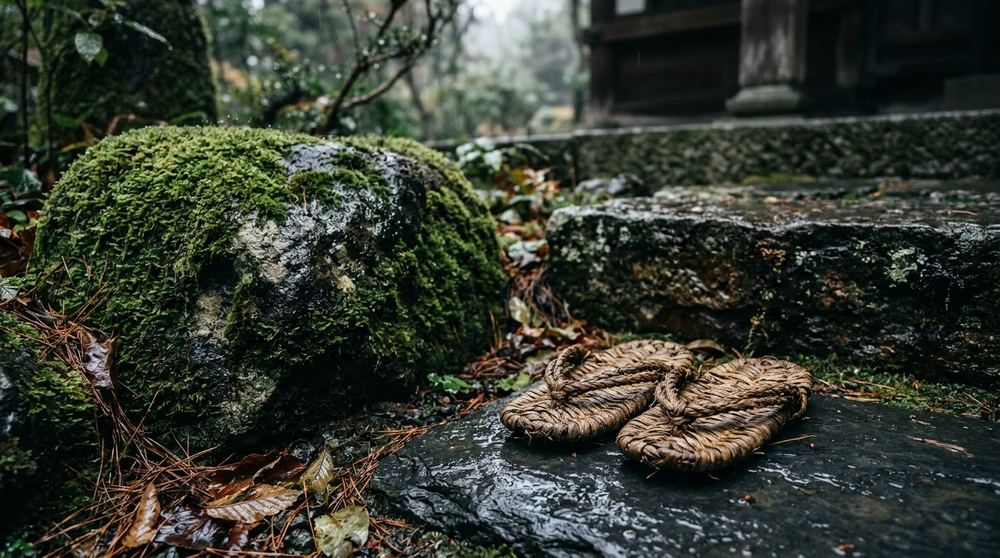
A few days later, when the sky cleared slightly, Fayan and his companions tied their straw sandals to leave. Master Guichen walked them down to the temple gate. Beside the muddy path stood a large, jagged boulder glistening with rainwater. Guichen stopped, pointed a weathered finger at the rock, and asked the young scholar:
“You often speak of the teaching that the three worlds are nothing but mind, and all things are nothing but consciousness. Tell me, then: is this stone inside your mind, or outside your mind?”
Fayan answered immediately, straight from the textbooks he had memorized: "From the standpoint of the teaching, everything is within the mind. Therefore, the stone is inside my mind."
The old master smiled gently and asked a single question that brought Fayan to a standstill:
"By what right does a wandering pilgrim carry such a heavy stone around inside his head?"
Fayan had no reply. For the first time, he realized that all his memorized theories were not wings; they were boulders. He untied his pack, laid his scholarly pride down on the temple steps, and remained with Guichen until he learned how to look at a wet stone without a single doctrine standing in between.
II. The Subtle Trap of "I Have Seen This Before" (「もう知っている」という静かな疲労)
The Fayan Wenyi Zen story stone in the mind points to a fatigue that is painfully familiar in adult life. When we are young or new to a craft, we pay fierce, humble attention. We listen to the exact tone of a colleague's voice; we read every line of a problem carefully; we look at our partner across the dinner table with genuine curiosity.
Then the years pass, and we become competent.
Competence is useful, yet it carries a hidden cost of expertise overthinking. Once we believe we understand a field, a relationship, or ourselves, we stop looking at what is actually in front of us and start looking at our own mental filing cabinet. Before a family member finishes their second sentence, we are already rehearsing our rebuttal because we think we know what they always mean. When a familiar knot of anxiety tightens in the stomach on Sunday evening, we immediately label it with old theories from books we read years ago.
Like Fayan on the mountain road, we walk through our days carrying a boulder of prior conclusions inside our heads, wondering why our shoulders ache by nightfall.
III. Zeami’s Three Beginners: What Shoshin Actually Means (世阿弥『花鏡』が語る、人生の三つの「初心」)
Five centuries after Fayan set down his stone, the Japanese playwright and aesthetic theorist Zeami Motokiyo (世阿弥, 1363–1443) gave this willingness to unlearn its most enduring name: Shoshin (初心).
In his secret treatise Kakyō ( A Mirror Held to the Flower, 1424), written for actors of the Noh theater, Zeami left the famous maxim Shoshin wasuru bekarazu (初心忘るべからず)—"Never forget the beginner's mind." In modern casual speech, this phrase is often flattened into a sentimental reminder to remember the enthusiasm of your first day on the job.
Yet the Zeami Kakyo shoshin meaning is far more rigorous and compassionate. Zeami wrote that a human life does not have only one beginning; it has three:
- Shoshin in youth ( Zehi no shoshin ): The raw, awkward humility of someone learning the basic steps for the first time, aware of how easily they can stumble.
- Shoshin in middle life ( Toki-doki no shoshin ): The willingness at thirty, forty, or fifty to abandon the techniques that brought yesterday's applause when life demands a new form.
- Shoshin in old age ( Rōgo no shoshin ): Meeting a body that has slowed down and a world that has changed with complete honesty, learning how to stand on the stage with an economy of movement you have never tried before.
For Zeami, the moment you reach a new decade of life, a new season of marriage, or a new chapter of grief, you are a novice again. Pretending that last decade's answers will carry you through today's questions is the surest way to lose the living flower of the art.
IV. Setting Down the Boulder in Daily Life (日々の暮らしで「頭の中の石」を下ろす)
Letting go of the "stone in the mind" does not mean throwing away your professional training or pretending you have learned nothing from past mistakes. Fayan did not forget how to read; he simply stopped mistaking the menu for the meal.
When you notice your mind feeling rigid, defensive, or exhausted by its own explanations, try three small shifts to return to Shoshin:
- Listen past the first thirty seconds: In your next conversation with someone you know well—a spouse, a longtime colleague, an aging parent—notice the exact second your brain says, I already know what they are going to say. Treat that thought as Fayan's boulder. Set it down on the floor beside your chair and listen as if you met them this morning.
- Trade explanations for sensory facts: When anxiety starts spinning a complex psychological theory about why your week is going poorly, step out of the commentary. Notice three raw, unlabelled facts instead: the temperature of the room, the weight of your shoes on the floor, the sound of rain or traffic outside the window.
- Honor the awkwardness of a new season: If you are entering a stage of life you have never lived through before, release the demand that you should already know how to handle it gracefully. Even a master actor on the Noh stage is a beginner the first time they play an elder.
V. A Quiet Takeaway (静かな余韻)
"An idea held lightly is a lantern for the road; an idea held as certainty is a boulder in your pack."
Reflection Question: Where in your work or relationships right now are you reacting to an old memory of how things usually go, rather than looking at what is actually standing in front of you today?