I. The Stick We Refuse to Put Down (私たちが手放せない「見えない棒」)
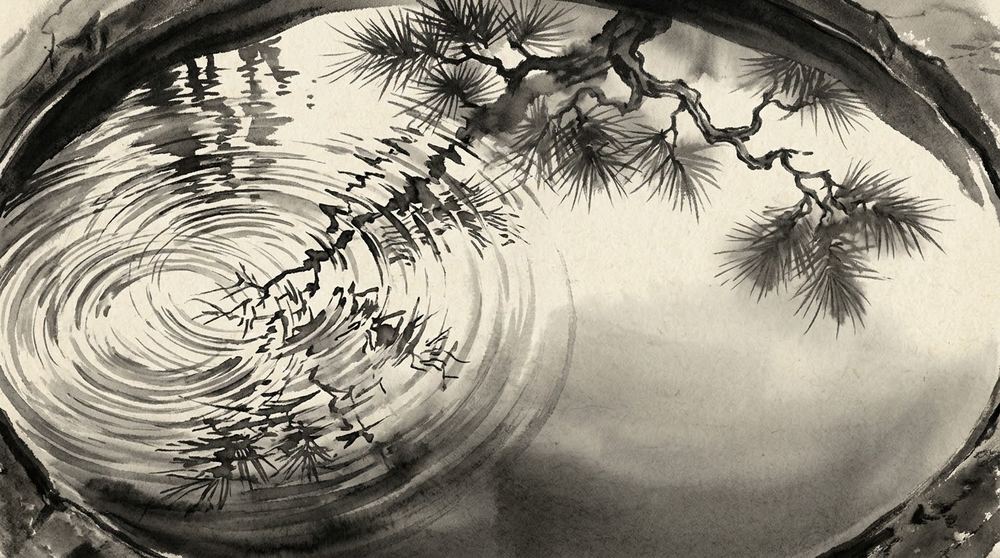
There is an old Zen teaching tale—passed down through monastery oral tradition ( denshō )—about a traveler who tried to clear a muddy stream by poking at the silt with a bamboo stick, only to discover that every stroke of his hand kept the sediment suspended in the water. Most people who hear that story nod in agreement with its ending: wait quietly, and the mud will sink. Yet in our actual Tuesday afternoons, almost none of us struggle with knowing that stillness is good. What we struggle with is the sheer, magnetic compulsion to keep our hand on the stick.
Why is it so hard to leave a question untouched for three hours? Because in modern life, the stick no longer looks like a piece of bamboo. It looks like refreshing an email inbox four minutes after sending a proposal. It looks like opening a messaging app to see whether the small "Read" receipt has appeared beneath our text, and then re-reading our own three sentences to see if our tone sounded too brisk or too eager. We tell ourselves we are merely "checking," as though checking were a neutral, weightless glance. In reality, every check is a fresh stroke of the stick across the bottom of the mind.
II. The Anatomy of the Re-Read (「送信済み」を読み返すときに起きていること)
Observe what happens in the body when you re-read an important message you have already sent. Before you open the sent folder, your nervous system is slightly uneasy—the natural vulnerability of having put a piece of work or an honest feeling out into the world where you can no longer control how it will be received.
To soothe that discomfort, you open the message and read it again. For approximately four seconds, you feel a tiny surge of relief: Good, there are no typos; it says what I meant. Yet by the fifth second, because your attention is now locked onto the words without any reply to anchor them, your imagination begins to supply the missing half of the conversation. You notice an adjective that could be misread. You wonder why the other person has not answered yet, even though it has only been twenty minutes. By the time you lock your phone screen, you are more anxious than you were before you looked—which guarantees that in another fifteen minutes, you will reach for the phone to check again.
III. The Illusion of Productive Vigilance (「気をつけている」という錯覚の代償)
We repeat this cycle—with emails, with bank balances, with medical test portals, with the facial expressions of people around us—because our minds confuse vigilance with control. When a farmer plants rice seedlings in early summer, checking on the paddy once at dawn to make sure the water level is steady is responsible stewardship. Walking out to the field every twenty minutes and pulling a seedling up by the roots to see whether the white fibers have grown a millimeter since noon is not diligence; it is sabotage disguised as care.
Compulsive checking carries a steep, hidden tax on our attention. Every time we interrupt a quiet afternoon to check whether an outcome has arrived, we pay in three currencies at once:
- We reset the emotional clock. Just as a wound cannot form a protective scab if we lift the bandage every ten minutes to inspect it, a nervous system cannot return to baseline if we re-expose it to the source of uncertainty twenty times an hour.
- We fragment the work in front of us. Even a ten-second glance at a notification bar leaves what cognitive researchers call "attention residue"—a trailing thread of thought that keeps part of our mind tethered to the inbox while we are trying to read a book or listen to a child.
- We train ourselves to distrust silence. When we demand instant reassurance, any natural pause in human communication begins to feel like a threat rather than normal life.
IV. Reassurance-Seeking in Conversation (行動に「区切り」をつける小さな作法)
The habit of stirring does not only happen on glass screens; it happens between people who care about each other. Have you ever had a small misunderstanding with a friend or partner, talked it through, received their sincere assurance that all is forgiven—and then found yourself bringing the subject up again two hours later just to "make sure we are really okay"?
The first conversation cleared the water. The second and third conversations, born from our inability to sit with the faint residual ache of having made a mistake, stir the silt right back up. By asking the other person to reassure us again and again, we subtly shift the burden of our own uneasiness onto their shoulders, turning a resolved moment into a lingering exhaustion.
V. Practicing the Clean Close
How do we put down the stick when our fingers are accustomed to reaching for it? The answer is not to scold ourselves for feeling anxious, nor is it to pretend we do not care about the outcome of our work or our relationships. Instead, we can practice what Japanese artisans call kugiri (区切り)—making a clean, deliberate boundary at the end of an action.
When you write an email or a message that matters, read it once with care before you press send. Once your finger taps the button, close the window immediately—do not leave the tab open in the background, and do not open the sent folder to admire or interrogate your own prose. Stand up, walk to the kitchen to pour a cup of warm hōjicha, or step onto the balcony for two breaths of outside air. Let your body register physically that the action is complete. The water in the stream will clear on its own schedule; your only job for the next three hours is to keep your hands in your pockets and let the pebbles find the bottom.