Pillar 01: Tales of the Elders (古智)
The Woodcarver Parable (Zhuangzi): How to Quiet the Mind Before Deep Work
Understanding the Zhuangzi woodcarver parable meaning begins with a quiet paradox: our best work rarely comes when we are trying hardest to impress. In this original story from ancient Daoist philosophy, a master craftsman creates a work of astonishing beauty only after letting go of outcomes , rewards, and royal judgment. By cultivating inner stillness before picking up his chisel, he shows us how to step out of performance anxiety and enter a state of unforced, clear-eyed concentration.
I. The Story: Artisan Qing and the Bell Stand (梓慶(しけい)、木を削りて鐻(きょ)を作る)
In the nineteenth chapter of the Zhuangzi—a section known as Mastering Life ( Dasheng / 達生)—there is an account of a master woodworker named Qing (梓慶).
Qing carved wood to make a ju, a tall ceremonial stand used to hang bronze chimes and bells in the royal court. When the stand was finally finished and carried into the hall, everyone who saw it fell silent. The curves of the wood seemed alive, as though shaped by mountain spirits rather than human hands. No one could see where the chisel had struggled.
The Marquis of Lu was so struck by the piece that he summoned the old craftsman and asked, "By what secret art did you make this?"
Qing bowed and replied, "I am only a workman. What secret art could I possibly have? Yet there is one thing."
He paused.
“When I am preparing to make a bell stand, I never dare to let it drain my vital energy (qi). I must first fast in order to quiet my mind.”
The Marquis listened closely as Qing described this quiet preparation—what Daoist thinkers call the fasting of the heart:
"After fasting for three days, I no longer dare to think of congratulations or rewards, of rank or payment. After fasting for five days, I no longer dare to think of praise or blame, of skill or clumsiness. After fasting for seven days, I become so still that I forget I have four limbs and a body. By that time, for me, the royal court no longer exists."
The noise fades away.
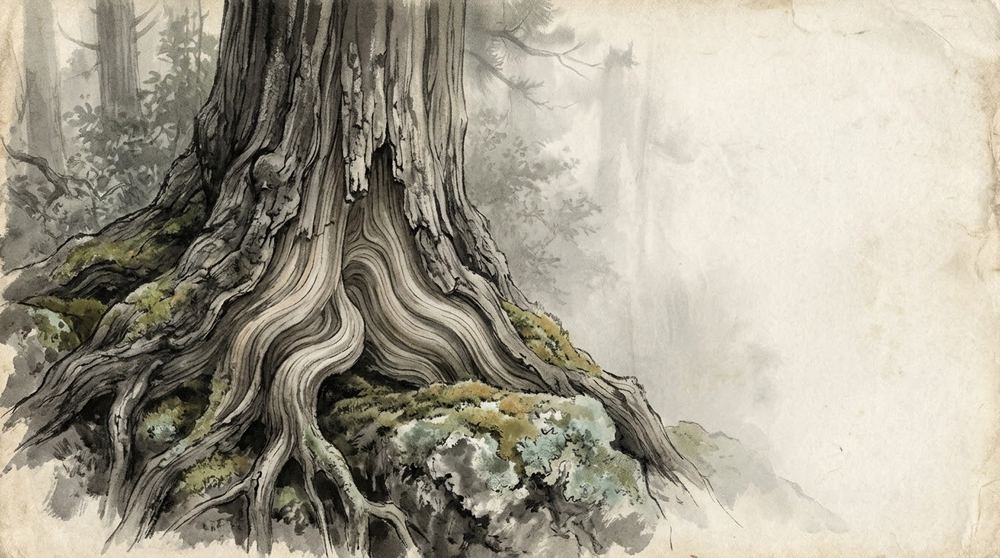
"Then," Qing continued, "my skill is concentrated, and all outside distractions have fallen away. Only then do I walk into the mountain forest. I observe the heaven-given nature of the trees. I look for a trunk whose natural form is already whole and unspoiled. When I see a complete bell stand standing right there inside the living tree, I put my hand to the work. If I do not see it, I lay my tools down and walk away."
He concluded with a simple truth: "In this way, I match my own innate nature with the innate nature of the wood. Perhaps that is why people think the work was done by spirits."
II. Meaning & Nuance: Fasting Away the Noise, Not the Craft (目標を捨てるのではなく、恐れを手放す)
At first glance, the Qing the woodcarver moral lesson might sound like an invitation to passivity—as if we should stop caring about quality or wait lazily for inspiration to strike.
Yet Qing is anything but careless. He is a master craftsman working on a commission for the ruler of Lu. He knows his tools, understands timber, and respects the weight of the bronze bells the stand must carry.
What Qing fasts away is not his dedication to the craft, but the invisible crowd standing over his shoulder. Notice the exact order in which his mental noise dissolves over those seven days:
- Days One to Three (Letting go of external gain): He releases thoughts of payment, promotion, and applause. These are the outermost layers of distraction—doing the work merely for what it will buy or the status it will bring.
- Days Four to Five (Letting go of praise and blame): This layer cuts deeper. Even when we stop caring about money, we still worry about looking foolish. We tense up over whether our work will be called "skillful" or "clumsy." By letting go of praise and blame , Qing frees his hands from the tremor of self-consciousness.
- Days Six to Seven (Forgetting the self and the court): Finally, the ego itself steps aside. He forgets his own body and the authority of the royal court. There is no longer an anxious "me" trying to conquer a stubborn piece of wood.
Ambition narrows our vision.
When we approach a project while secretly calculating how it will be judged, we force our preconceived ideas onto the material. We cut against the grain because we are in a hurry to prove ourselves. When Qing empties his mind of the court, he can finally see the tree as it actually is.
III. Echoes in Japanese Thought: Mushin, Shokunin, and Ma (無心、職人気質、そして「間」)
Centuries after the Zhuangzi was written, Artisan Qing's seven-day fast found a quiet home in Japanese aesthetics and craftsmanship.
In Zen and the traditional Japanese arts ( Geido / 芸道), this state of unclouded presence is called Mushin (無心)—often translated as "no-mind." Mushin does not mean an empty head or a blank trance. It refers to a mind that does not stick or snag on passing thoughts. Just as a polished mirror reflects whatever stands before it without holding onto the image, a craftsperson in Mushin responds directly to the material in front of them, unimpeded by hesitation or pride.
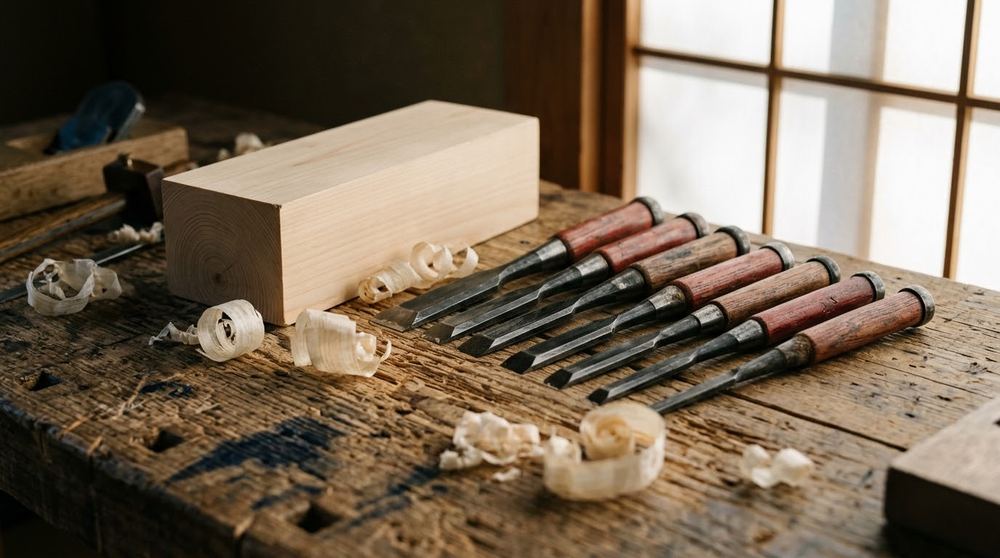
You can also see Qing's spirit in Shokunin kishitsu (職人気質)—the quiet ethos of the traditional Japanese artisan. A true shokunin does not work for the applause of the gallery; their responsibility is to the integrity of the material itself. Before a master carpenter pulls a Japanese hand plane ( kanna ) across a board of hinoki cypress, they spend hours sharpening the blade on wet stones and reading the direction of the wood fibers. They work with the tree's nature, never against it.
And between the decision to build and the first strike of the chisel lies Ma (間)—the intentional pause.
Silence precedes the stroke.
In modern work, we treat the pause before action as wasted time. Qing reminds us that the seven days spent sitting in silence are not a delay before the work begins; they are the most essential part of the work.
IV. In Daily Life: Clearing the Workbench of the Mind (仕事の前に「心の作業台」を整える)
We may not carve ceremonial bell stands for ancient courts, yet we know the exact weight of the "royal court" in our own lives.
Think of the last time you sat down at your desk to write an important proposal, prepare a difficult presentation, or solve a complex design problem. Before your fingers even touch the keyboard, the room is already crowded. You can hear your manager's potential critique, compare yourself to a colleague's recent success, or worry about what happens if the project falls flat.
Our hands grow heavy.
This is where Eastern philosophy on focus and anxiety offers a practical antidote. We cannot do deep, original work while half of our attention is busy defending our reputation. Before entering a demanding task, we need our own brief version of Qing's fasting of the heart to clear away mental clutter and return to a beginner's mind :
- Name the "court" and step outside it: Before starting a 90-minute block of deep work, take two minutes to notice whose approval you are secretly chasing—a client, an algorithm, a critic. Acknowledge that their judgment belongs to tomorrow. For the next hour, the court does not exist.
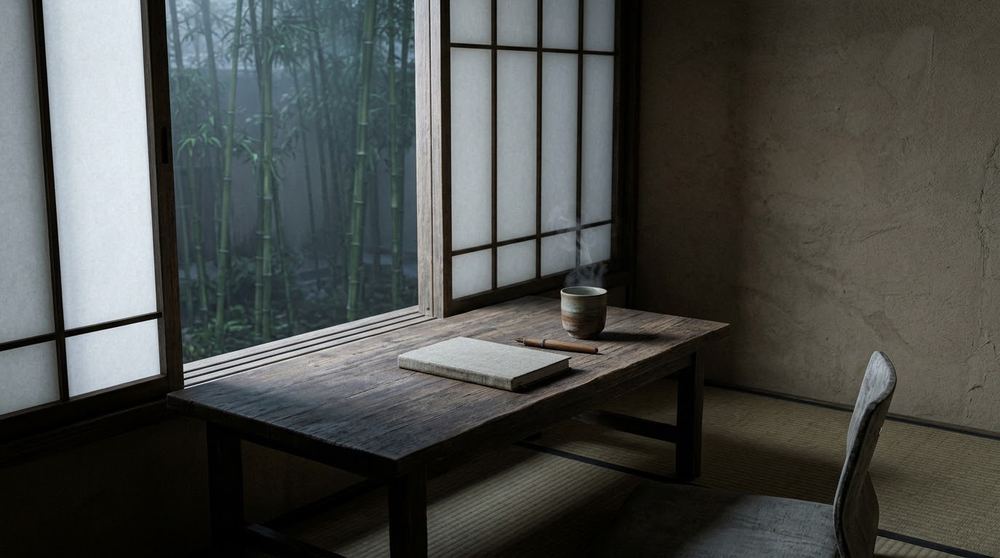
- Create a three-breath threshold: You do not need seven days in a mountain forest to practice non-striving . Sit still in front of your closed notebook or dark screen. With the first slow exhale, let go of the reward. With the second, let go of looking clever or clumsy. With the third, bring your attention down to the physical sensation of your hands resting on the desk.
- Look for the "tree" before forcing the cut: Instead of forcing a rigid outline onto a problem when you are exhausted, spend the first ten minutes simply observing the raw material—reading the notes, listening to the question, and waiting until the natural shape of the solution begins to show itself. That quiet alignment is the true doorway into a genuine flow state .
V. A Quiet Takeaway
"The chisel cuts cleanest when the hand no longer trembles for applause."
A question to sit with today: Before you begin your most important work today, whose invisible eyes are watching you—and what would happen if you gently asked them to leave the room?