I. The Compulsion to Explain Everything (すべてを照らし出そうとする時代の疲れ)
We live in an era of high-definition exposure. Every product photograph is lit from four angles so that no shadow remains; every social media caption explains the exact emotion we are meant to feel; every professional profile lists every credential lest a stranger underestimate us. We have been trained to believe that clarity requires total visibility—that if something is not stated explicitly and displayed in bright light, it might as well not exist.
Yet think of the moments that actually linger in your memory for years. It is rarely the floodlit stadium or the exhaustive explanation. More often, it is a half-sentence spoken by a friend at a train station before the doors closed, or the outline of a mountain ridge disappearing into evening rain. Classical Japanese aesthetics has a name for this resonant, unstated depth: yūgen (幽玄).
II. Kamo no Chōmei and the Words That Are Not Spoken (鴨長明『無名抄』が語る、霧の向こうの秋山)
Composed of two characters— yū (幽), meaning dim, faint, or secluded, and gen (玄), meaning dark, profound, or mysterious— yūgen entered Japanese poetics from Chinese philosophical texts and reached its most luminous definition in the early Kamakura period. Around 1211, the poet and recluse Kamo no Chōmei (1155–1216) attempted in his poetic treatise Mumyōshō (Nameless Notes) to explain why yūgen is so powerful precisely because it refuses to name everything aloud.
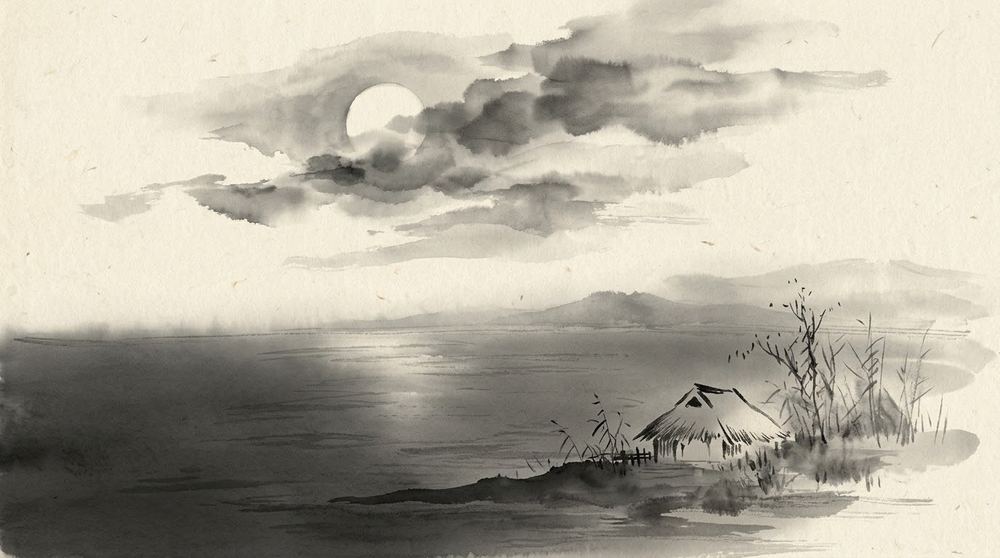
Chōmei wrote that yūgen resides in the yojō —the lingering resonance that floats beyond the literal words, and the unseen landscape that rises in the mind’s eye without being described. To make this tangible, he offered an image from nature: on an autumn evening, we look out at a sky that has no distinct color or spectacle, yet for reasons we cannot quite articulate, our eyes are moved to tears. Someone without sensibility, Chōmei noted, demands to see a bright, cloudless sky where every scarlet maple leaf is visible at once. True depth, however, is like watching the autumn moon when a thin bank of mist drifts across its face, or glimpsing the scarlet foliage of a mountain peak through a veil of fog. Because nine-tenths of the mountain is hidden, the imagination senses a vastness that no fully exposed panorama could ever provide.
III. Three Places Where Yūgen Lives: Verse, Moss, and Unpainted Clay (和歌と苔庭と備前焼に宿る「言わぬ深み」)
We can witness this principle at work across three distinct Japanese traditions. The first is the waka poetry of Fujiwara no Teika (1162–1241), compiled in the Shin Kokin Wakashū (New Collection of Ancient and Modern Poems, 1205). In one of his most celebrated verses, Teika writes of looking out along the shore at dusk where there are neither cherry blossoms nor crimson autumn leaves—only a reed-thatched hut standing in the gathering autumn twilight ( Aki no yūgure ). By naming the absence of bright colors first, Teika conjures their memory in the reader’s mind before letting them dissolve into the gray-blue stillness of the bay.
The second is the moss garden of Saihō-ji (often called Kokedera) in western Kyoto, reshaped in the fourteenth century by the monk Musō Soseki. When you walk beneath its canopy after rain, you do not see geometric flowerbeds announcing themselves in primary colors. Instead, over a hundred varieties of green moss absorb the sound of footsteps while morning mist drifts between the tree trunks, obscuring where the garden ends and the mountain forest begins.
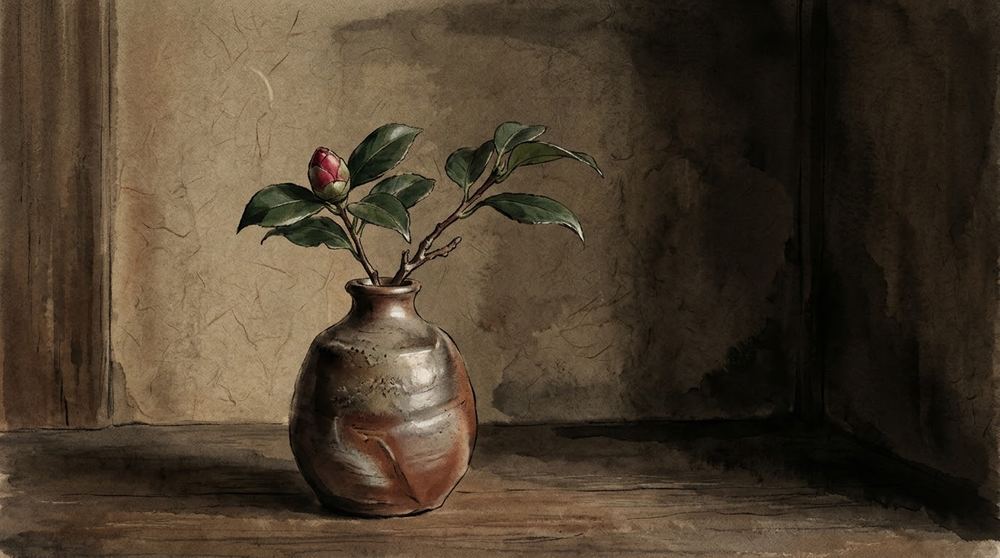
The third is unglazed Bizen ware ( Bizen-yaki ), fired in wood-burning kilns for up to two weeks without a single drop of decorative glaze. Set in the dim recess of a tokonoma alcove, a Bizen vase does not shine. Only when you sit quietly in the room and your eyes adjust to the low light do you begin to notice the subtle reddish-brown hidasuki cord marks and natural ash deposits left by the kiln fire—a surface that rewards slow looking rather than demanding instant attention.
IV. What Over-Visibility Does to Our Relationships (暮らしのなかに「柔らかい影」を残す)
When we bring the lens of yūgen back to our everyday lives, we begin to see why modern communication often feels both loud and strangely hollow. When we feel anxious in a conversation, our habit is to over-explain: we pile on justifications, fill every pause with commentary, and try to control how the other person interprets our words. In doing so, we leave our listener with no yojō —no quiet room in which to meet us halfway.
The same exhaustion happens when we turn our personal lives into a brightly lit display window. When every small joy, meal, or reflection is immediately photographed and captioned for public consumption, the experience loses its protective mist. A moment that might have deepened quietly inside us is flattened into a surface image.
V. Leaving a Corner of the Room in Soft Shadow
Practicing yūgen in daily life is not about being secretive or aloof; it is about trusting the intelligence of what remains unsaid. In a conversation with someone you love, it can mean offering one honest, unadorned sentence and allowing the silence afterward to carry the weight of your care, rather than rushing to explain yourself. In your work, it means resisting the urge to announce every effort before it has matured.
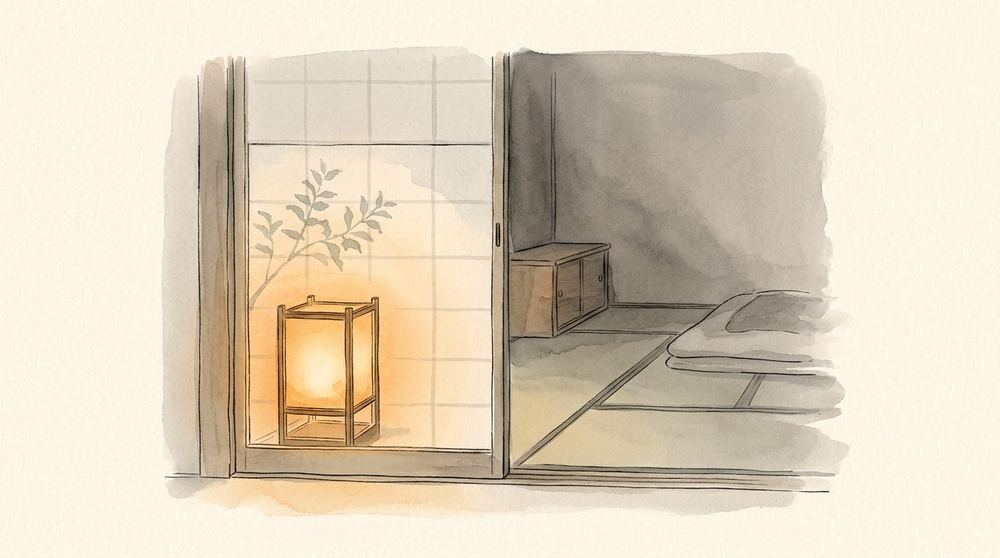
Even in our homes, we can turn off the harsh overhead ceiling light an hour before sleep and let a single low paper lantern ( andon ) warm one corner of the room while the rest recedes into gentle shadow. We do not need to see every wall at once to know we are safe. Often, the richest part of a life is the part we allow to remain unannounced—like the mountain behind the autumn mist, felt all the more deeply because we did not insist on stripping away the clouds.