Understanding the Japanese craft philosophy of slowness begins inside workshops where the clock on the wall has very little authority. In traditional natural indigo dyeing ( Aizome ) and midwinter papermaking ( Kan-zuki Washi ), artisans do not measure progress by how hard they push, but by how attentively they cooperate with fermentation, cold water, and seasonal weather. Their quiet routines reveal why certain depths of character, clarity, and creative work simply cannot be manufactured on demand.
I. The Living Vat of Tokushima Indigo (「藍の花」が咲くのを待つ、土の中の甕)
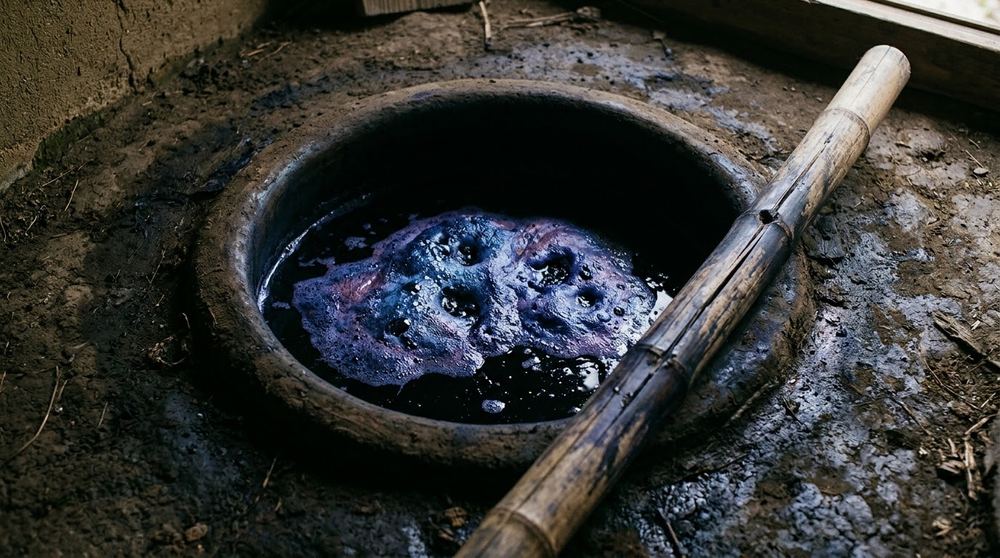
Walk into a traditional indigo dye house ( kon-ya ) in Tokushima Prefecture at dawn, and the first thing you notice is the earthy, slightly sweet scent of steamed leaves and wood ash rising from the floor. Sunk deep into the packed earth are rows of large ceramic vats ( aigame ), their rims flush with the ground so the soil can insulate the liquid inside.
Unlike synthetic chemical dyes that color a shirt in ten minutes, traditional Japanese indigo begins with sukumo —polygonum indigo leaves that have been piled on an earthen floor by specialized masters ( ai-shi ), watered, turned with bamboo rakes, and fermented for exactly one hundred days from autumn into the dead of winter.
Even after the composted leaves arrive at the dye house, the dyer cannot force the color. The sukumo is mixed with wood-ash lye, slaked lime, and wheat bran, then left to awaken slowly over ten to fourteen days. The dyer stirs the dark liquid once a day with a wooden pole, listening to the sound of the swirl and watching the center of the vat. Only when a cluster of iridescent, violet-blue bubbles—affectionately called ai no hana (藍の花), the "indigo flower"—blooms at the surface is the living bacteria ready to receive cloth.
And here lies the aizome natural indigo fermentation meaning that surprises every impatient visitor: a vat can get tired.
If a dyer grows greedy and dips too many bolts of linen in a single afternoon, the oxygen introduced into the vat exhausts the microorganisms. The blue turns dull and gray. No amount of stirring or heating will force the vat to work faster. The dyer must cover the earthen rim with a wooden lid, feed the bacteria a spoonful of warm sake or wheat bran, and walk away until tomorrow.
II. Mulberry Bark in the January Stream (一月の凍える川に、楮(こうぞ)を晒す理由)
Hundreds of miles north in the mountain villages of Mino, Echizen, and Tosa, a second seasonal rhythm unfolds during the coldest weeks of January and February. This is the season of Kan-zuki (寒漉き)—midwinter papermaking.
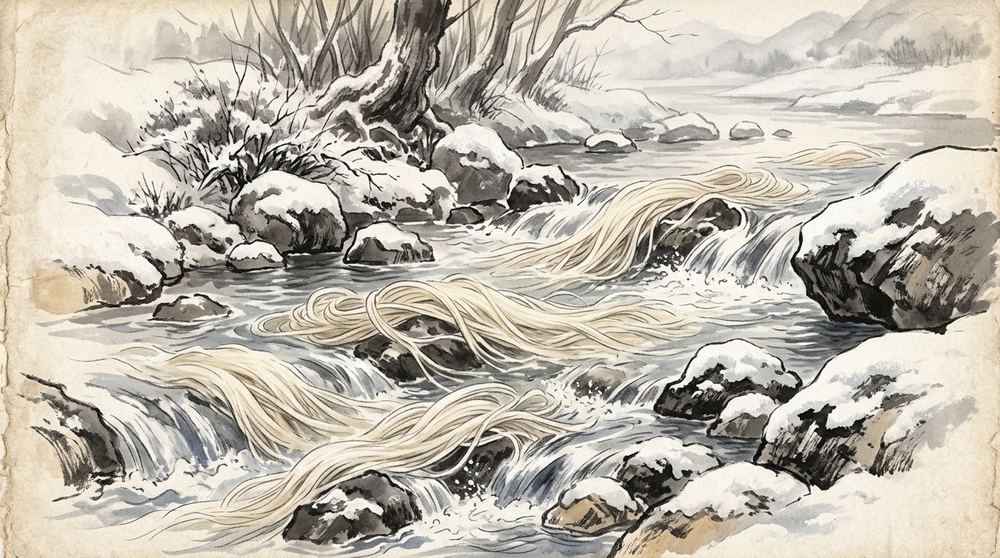
To make archival Washi paper that can survive for a thousand years without yellowing or turning brittle, papermakers harvest the inner bark of the kōzo (paper mulberry) shrub after the autumn leaves have fallen. Before the fibers are beaten with wooden mallets and scooped onto bamboo screens, bundles of stripped bark are laid directly into the icy, fast-flowing waters of a mountain river—a process called kawa-zarashi (川晒し, river-bleaching).
Modern industrial mills use chlorine bleach and heated vats to whiten pulp in an hour. The chemical shortcut works quickly, but it eats away at the cell walls of the fiber; within a few decades, chemical paper crumbles at the edges.
In the freezing January stream, something entirely different happens. The cold water naturally contracts and tightens the kōzo fibers while washing away soluble starches and impurities without bruising a single strand. Simultaneously, the low winter sun and snow reflection gently lighten the bark to a warm, luminous ivory. The papermaker's hands ache from the icy water, yet every artisan knows that paper made in the heat of summer—when bacteria multiply quickly in warm water and fibers loosen—can never match the crisp strength and quiet translucence of sheets formed in the deep cold.
III. Why Hurry Weakens the Fiber (心の繊維を傷めないための、日々の暮らし方)
Taken together, the kanzuki winter washi papermaking lesson and the sleeping indigo vat expose a blind spot in how we treat our own minds.
We live in a culture that treats every human faculty as if it were an industrial machine. If we are confused about a life decision, we expect a weekend worksheet to bleach the ambiguity white by Monday morning. If we are exhausted after months of output, we try to stir the vat harder with more caffeine, stricter schedules, and louder self-discipline, wondering why our work keeps coming out pale and gray.
Chemical shortcuts always bruise the fiber.
When you force yourself to produce a premature conclusion before an idea has had time to ferment in the back of your mind, the result may look bright for a week, but it does not hold its color. And when you resent a "winter season" in your career or emotional life—a quiet, cold stretch where nothing seems to be expanding outward—you miss the fact that cold water is what tightens the grain and washes out the starch that would otherwise rot later on.
IV. Practicing Unhurried Time in Daily Life (静かな余韻)
Bringing unhurried time in daily life into a modern schedule does not require moving to a mountain village or giving up deadlines. It means learning to distinguish between tasks that belong to the machine and processes that belong to the vat:
- Recognize when your "vat" is tired: Notice the exact moment in the afternoon when your sentences turn flat, your patience thins, and you are reading the same paragraph three times without absorbing it. Instead of dipping another bolt of cloth into an exhausted mind, put the wooden lid on the work. Step outside for twenty minutes or leave the problem overnight so the microorganisms of intuition can recover.
- Stop bleaching away the winter: If you are in a cold, slow period of transition where outward results are scarce, resist the urge to panic or force a flashy decision just to feel productive. Treat this month like kōzo bark resting in the January stream—a time for simplifying your habits, clearing out old clutter, and letting your inner resolve tighten quietly.
- Leave a hundred-day shelf for what matters: Keep one project, one relationship, or one creative notebook in your life that is completely exempt from quarterly metrics—something you tend once a day with a gentle stir, allowing it to deepen layer by layer over seasons rather than hours.
V. A Quiet Takeaway
“Bleach can whiten a page in an hour, but only the winter river gives the paper a thousand years of life.”
Reflection Question: Which area of your life right now are you trying to force with chemical speed when it actually needs the quiet, covered rest of a fermenting indigo vat?