I. The Hand on the Mouse at Four O’Clock (午後四時のマウスと、スマートフォンの角)
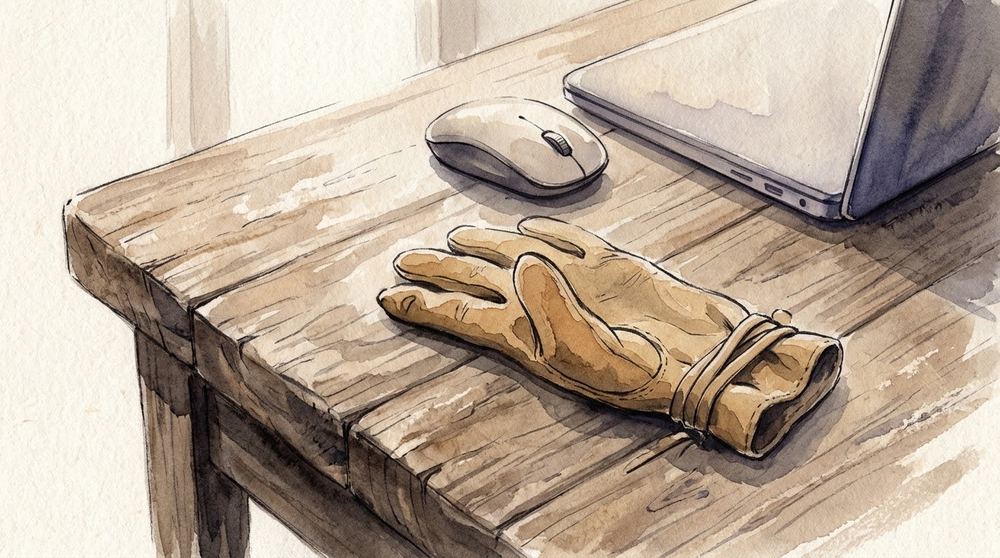
Pause for a moment in the middle of a demanding afternoon and check what your dominant hand is doing. If you are working at a computer, there is a high probability that your fingers are pressing the plastic shell of the mouse with three times the force required to move the cursor across the screen. If you are standing on a crowded commuter train reading the news on your phone, your thumb and palm are likely clamped around the aluminum edges as though someone were about to snatch the device away.
We rarely notice this muscular clenching until our forearm aches or our shoulders have crept halfway up toward our ears. The human hand evolved with a powerful flexor reflex: when an infant is startled, its fingers curl inward automatically; when a climber slips, the tendons lock around the rope before conscious thought can intervene. In moments of physical danger, that reflex saves our lives. The trouble is that our nervous system cannot tell the difference between a cliff edge and a difficult email—or between a physical rope and an outgrown relationship. When we feel threatened, uncertain, or afraid of losing our footing, our first biological instinct is to tighten our grip.
II. Why Rope Burn Only Happens When We Refuse to Open Our Palm (掌(てのひら)に火傷ができるほんとうの理由)
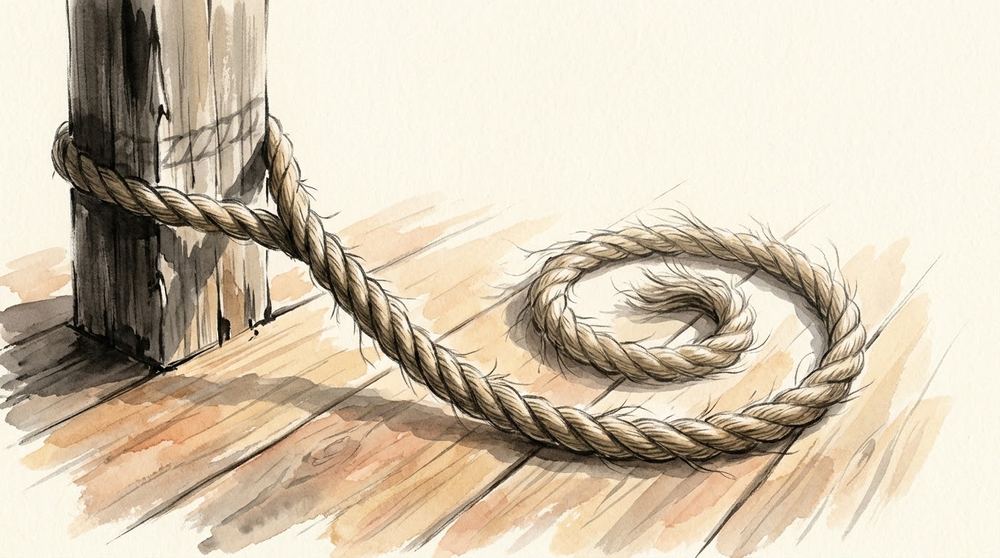
Anyone who has ever handled a heavy hemp line on a sailboat or in a timber yard knows the counterintuitive physics of rope burn. A rope lying slack in your palm never blisters the skin. Even a rope that is pulled out of your open hand all at once leaves your palm intact. The searing friction—the heat that tears the skin—happens only in the exact moment when a force much larger than you is already moving away, and you clamp your fingers shut in a desperate attempt to stop it from moving.
Look at the areas of your life that currently feel raw and abraded, and you will almost always find this exact mechanical friction at work. A friendship has naturally shifted into a quieter season as two lives diverge; instead of letting the line run gently into its new length, we grip harder, demanding the same frequency of contact we had five years ago. A professional role or identity that once fit us well has reached its natural completion; out of fear of who we will be without the title, we white-knuckle the position long after the joy has left it. What hurts us is rarely the fact that life is moving. What burns our palm is our insistence on using our fingers as a brake against time.
III. What Japanese Archery Teaches About the Clenched Fist (弓道が教える「脱力」と「離れ」の秘密)
In traditional Japanese martial and contemplative arts, few disciplines study the anatomy of the grip more rigorously than Kyūdō (弓道)—the Way of the Bow. A Kyūdō bow ( yumi ) is over two meters long and requires significant physical strength to draw. When a beginner steps onto the polished wood floor of the kyūdōjō and attempts to pull the bowstring back to full draw ( kai ), their immediate instinct is to squeeze the bow handle with their left fist and clamp the string with their right fingers.
Every master instructor gives the same correction: as long as your fingers are clenched tight, the arrow will never fly straight. When the hand grips with anxious muscular force ( riki ), the shoulders stiffen, the chest collapses, and at the moment of release ( hanare ), the fingers snag the string, sending the arrow wobbling off target.
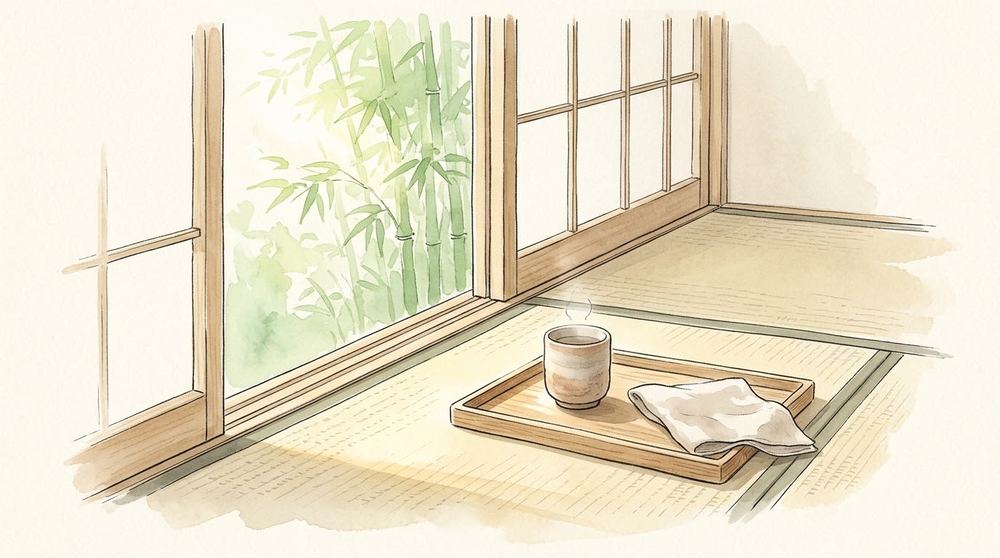
To shoot well, the practitioner must learn datsuryoku (脱力)—the deliberate draining away of excess, fearful tension so that the bones and posture carry the load rather than the small, panicking muscles of the hand. In Kyūdō, the release is not an aggressive throwing away of the string; it happens naturally, like snow sliding off a bamboo leaf when the fullness of the draw is reached and the grip simply softens.
IV. Why We Confuse Tension With Care (指をほどくことから始まる三呼吸)
Why is datsuryoku so difficult for us outside the training hall? Because somewhere along the way, we began to confuse tension with responsibility. We secretly believe that if we are not clenching our jaw over a family problem, we do not love our family enough. We assume that if we are not holding every detail of a project in a vise-like grip at midnight, we are being careless professionals.
Yet just as a clenched fist ruins the flight of the arrow, an over-gripped life ruins the very things it tries to protect. Hold a small bird or a delicate ceramic cup with a rigid, terrified fist, and you will crush what you meant to keep safe. Hold a partner or a growing child with a possessive grip, and they will spend all their energy trying to pry your fingers open so they can breathe. Care requires an open, steady palm—a surface that supports without trapping.
V. A Three-Breath Practice for Uncurling the Fingers
Because the habit of gripping lives in the body before it becomes a philosophical argument in the mind, the most reliable way to loosen a mental fixation is to start with the actual hands at the ends of your arms.
Three times today—when you sit down at your desk, when you are waiting at a traffic light, and before you close your eyes at night—try a simple physical check:
- Look down at your hands. Notice how much force your fingers are currently using to hold the steering wheel, the pen, the phone, or even the edge of your own sleeve.
- Reduce the grip by eighty percent. Do not drop the object; simply soften your fingers until you are using the minimum possible contact required to let it rest in your hand. Let your thumb uncurl. Let your tongue drop from the roof of your mouth.
- Ask what your mind is squeezing in the same way. Name the one conversation, expectation, or outgrown role you have been white-knuckling this week, and practice holding it the way a Kyūdō archer holds the bow at full draw: present, attentive, and ready to let the string go the moment its season is complete.