Japanese has one word for something English needs a sentence to describe: komorebi (木漏れ日), the sunlight that reaches the ground after slipping through leaves. The word is assembled from three pieces — ko (木, the older combining form of ki, tree), more (漏れ, from moreru, to leak or escape through a gap), and hi (日, sun or daylight), which shifts to bi by the ordinary sound change called rendaku. Tree-leak-sun. Once you know that, the noun stops being decorative and turns into a small instruction: look at what gets through, not at what is blocked.
I. A Word Made of Three Parts (木漏れ日という三つの部品)
Dictionaries are careful about age, and it is worth being careful with them. The Shōsenban Nihon Kokugo Daijiten gives the earliest recorded written example as Wakayama Bokusui's poetry collection Rojō (1911), in a tanka describing a dog sitting in the komorebi in front of the poet's face, in the shade beneath a cedar. That citation is the oldest surviving printed use, not the year the word was coined — a distinction most retellings of the word's history quietly skip. A poet can only use a word that his readers already recognise; the phrase had to be ordinary before it could become literature.
English has "dappled light", and forestry manuals have "canopy shade", but neither names the moving thing itself. That is why the Japanese word travels so easily through design writing, and why it is so often quoted badly — as decoration rather than as a description.
II. Uniform Light Flattens Attention (均一な光は注意を平らにする)
An office ceiling, a phone screen and a supermarket aisle share one property: the light does not change. Nothing in that light tells you where you are in the day. When every hour looks the same, attention stops being pulled by the world and starts being pulled by whatever makes noise. As we looked at in The Empty Teacup: Finding Quiet in an Overflowing Mind, mental fatigue rarely comes from thinking too deeply; it comes from switching without pause.
Komorebi is the opposite kind of light. It is never identical twice: the wind moves a branch, the pattern on the moss redraws itself, and the geometry of one second is not repeated in the next. Watching it is not a meditation technique. It is simply a case where the world supplies change without supplying demand — the rarest combination a distracted mind can meet.
III. The Engawa Sits Between (縁側という「間」)
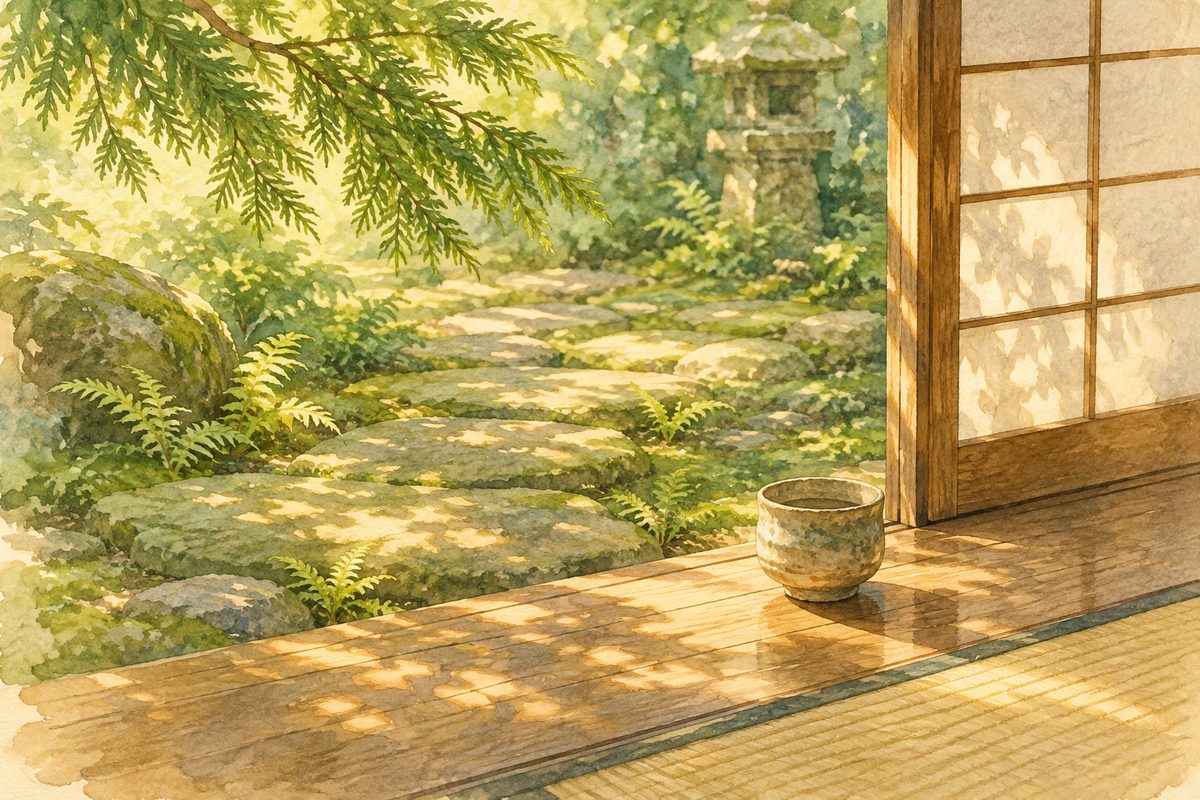
Traditional Japanese houses answered the same problem in wood. The engawa (縁側) is the narrow strip of plank flooring that runs along the outside of the rooms, sheltered by the eaves, between the paper sliding screens and the garden. Interior designers describe it as belonging to both sides and to neither: seen from the garden it reads as part of the house, seen from indoors it reads as part of the garden. Two variants are usually distinguished — irikawa-en, set inside the outer shutters and therefore usable in any weather, and nure-en, set outside them, where nure means wet and the name is honest about the consequence.
The engawa is not a room and not a porch. It is where you sit to put on your shoes, where you speak to someone standing in the garden, where you watch rain without being in it. None of those are activities that a floor plan budgets square metres for, which is exactly why modern open-plan houses tend to lose them.
IV. Shadow Carries Information (影は情報を運ぶ)
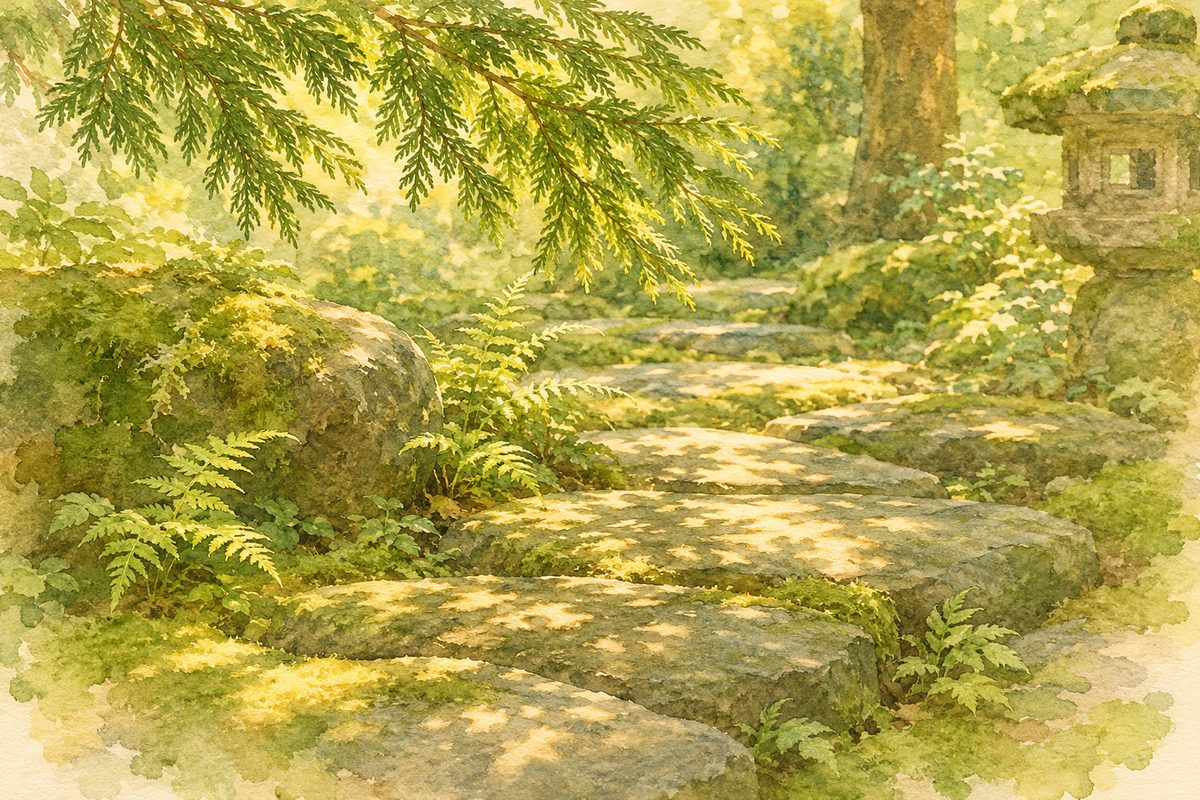
Look at the pattern komorebi leaves on a stone path and you are reading a description of the tree: how dense the leaves are, where the gaps have opened, which way the branch has grown since last year. The visible shafts appear because light scatters off fine particles suspended in the air — the Tyndall effect — which is also why a beam is easier to see in a dusty room than in a scrubbed one. The physics and the poetry do not compete. The shafts are legible precisely because the air is not empty.
A feed works the other way. It is engineered to deliver the same brightness at every hour, in every place, so that nothing on the screen tells you whether it is morning or midnight. The result is a strange flatness: plenty of stimulation, very little information about where you actually are.
V. Practising Komorebi Attention (木漏れ日のように見る練習)
Three exercises, none of which needs a forest.
1. One surface, five breaths. Before you open messages in the afternoon, stand where daylight reaches a single object — a table edge, a wall, a leaf on a balcony — and watch only that surface until five slow breaths have finished. Not as a ritual. As a way of letting the eyes report something that is not asking anything of you.
2. Sit on the threshold. Find the place in your home that is neither fully inside nor fully outside — a step, a balcony edge, a doorway — and sit there for ten minutes with the phone in another room. The point is not the view. The point is that a threshold gives you somewhere to be without a task attached to it.
3. Leave the margin. The Japanese idea of ma (間) is the interval that makes a sequence readable: the pause between phrases, the empty band in a painting, the gap in the leaves. Komorebi depends on the same arithmetic. Dense enough to break the light, sparse enough to let it through — a rhythm, not a wall.
VI. What a Slow Ledger Records (ゆっくりした台帳に残るもの)
Attention is not a muscle that grows by strain; it is a habit of returning. Every time you notice that the light has moved two centimetres across the floor, you rehearse the smallest version of the skill that reading, conversation and any craft depends on: noticing that something is different from a moment ago.
Komorebi will not make anyone more productive by the hour. It does something less commercial. It restores time to being something that passes rather than something that is spent, and it asks for nothing in return except a few minutes in which you are not being measured.