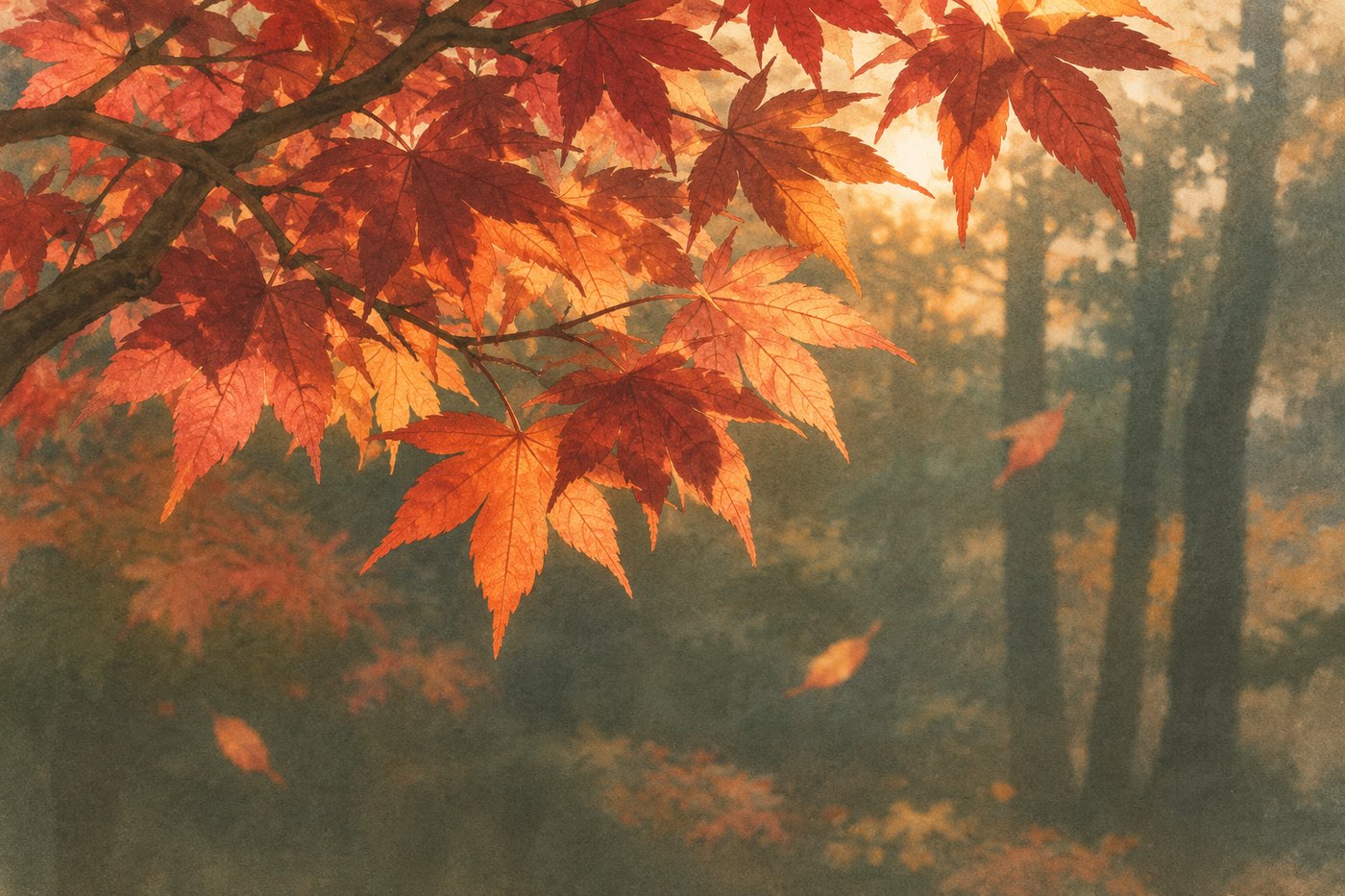
Every November along the mountain streams of Arashiyama and Nikko, Japanese maple trees (もみじ, Momiji) perform a quiet miracle before the first winter frost arrives. Rather than clinging stubbornly to their summer chlorophyll until the branches snap under heavy December snow, the trees draw their vital sap inward toward the trunk and turn their leaves into radiant canopies of amber, rust, and crimson.
Then, at the slightest touch of an evening breeze, the maple releases its leaves one by one. There is no struggle in their falling. They spiral gently onto the damp moss and cold river stones below, forming a thick, protective blanket over the soil.
I. The Ecological Wisdom of the Falling Leaf (紅葉が教えてくれる手放し方)
Botanists remind us that fallen autumn leaves are never wasted. Throughout the dark months of January and February, snow and forest microbes slowly break down those crimson leaves into rich humus, returning minerals directly to the very roots that grew them. If the tree refused to let go of yesterday’s foliage, its branches would splinter in the winter blizzards and its soil would grow barren.
“Letting go is not losing; it is returning yesterday’s season to the earth with gratitude so tomorrow’s buds have the strength to bloom.”
In classical Japanese literature, this gentle acceptance of seasonal change is what the eighteenth-century scholar Motoori Norinaga named Mono no aware (物の哀れ) — a tender, unbitter awareness of transience. We suffer deeply when we demand that every chapter of our lives remain in perpetual July: when we cling to an old resentment, an outgrown role, or a season of youth that has naturally completed its work.
II. Distinguishing Surrender From Defeat (「諦める」ことと「明らかに見る」こと)
The Japanese verb akirameru (諦める) is usually translated as "to give up", but it is commonly traced back to akiraka (明らか), "clear, plain, evident" — the same 諦 that renders the Buddhist word for truth. To release what has reached its natural autumn is not cynicism or defeat; it is seeing the rhythm of life clearly enough to stop fighting the calendar.
Think of an old misunderstanding with a relative or a mistake you made five years ago that you still rehearse in the shower. Holding onto that dry leaf does not change the past autumn; it only shades your present morning from the sun.
III. Trusting the Unseen Work of Winter (冬の静けさが春の芽吹きを準備する)
To an impatient eye, a bare maple tree in January looks inactive. Yet beneath the frozen bark, the tree is resting deeply and concentrating the sugars that will push fresh green buds into the April sky. When a chapter of our career or family life closes, we too need an unhurried winter of quiet reflection rather than immediate noise.
An Autumn Walk of Release (晩秋の散歩と手放しの儀式)
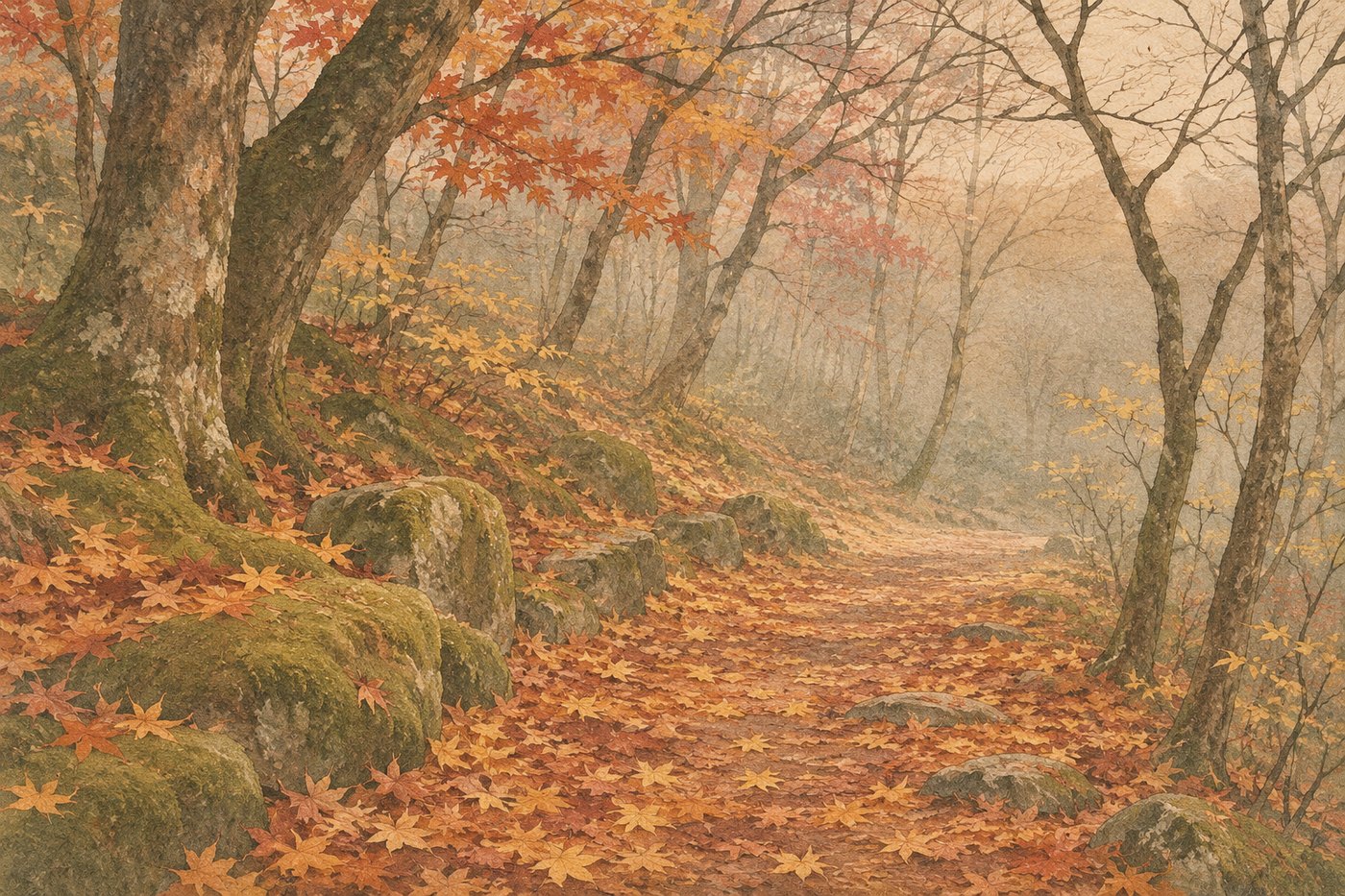
On your next quiet walk outdoors, pick up a single fallen leaf from the path. Hold it in your palm and name one outdated worry, comparison, or grievance you have been carrying out of habit. Then set the leaf gently onto the earth beside the trail, thanking the past season for what it taught you, and walk home with empty, open hands ready to welcome the quiet clarity of winter and the fresh buds of spring.