Takuan Soho and Fudoshin: The Martial Art of a Mind That Does Not Stop
I. The Misunderstanding of the "Immovable" (「動かない心」という誤解)
When we hear the Japanese word fudōshin (不動心)—usually translated into English as "immovable mind"—we tend to picture something heavy, rigid, and unyielding: a granite boulder standing in the surf, or a stoic face that refuses to flinch under pressure. When life becomes chaotic at work or at home, we try to imitate that boulder. We clench our jaw, narrow our focus, and try to hold our mind completely still so nothing can shake us.
Yet anyone who has tried to live as a stone knows how brittle that posture actually is. When we brace ourselves rigidly against one problem, we become blind to everything else happening in the room. In the early seventeenth century, the Rinzai Zen master Takuan Sōhō (1573–1645) wrote a famous letter to Yagyū Munenori, the head of the Yagyū Shinkage-ryū school of swordsmanship and martial instructor to the Tokugawa shoguns. In that treatise—titled Fudōchi Shinmyōroku (The Mysterious Record of Immovable Wisdom)—Takuan explained a paradox that surprises almost everyone who reads it for the first time: an "immovable mind" is a mind that never stops moving.
II. What Happens When the Mind Stops on the Blade (剣先に心が「留まる」とき、人は負ける)
Takuan was writing to a man whose profession left zero margin for theoretical vagueness. In a duel, a fraction of a second of mental hesitation meant death. Using the concrete mechanics of swordsmanship, Takuan asked Munenori to notice what happens the instant a swordsman’s attention "stops" ( tomaru ) on any single thing.
If the swordsman fixes his mind on his opponent’s sword blade, his mind is captured by that blade; in that split second of fixation, he loses the freedom to respond to a feint. If he stops his mind on his own intention to strike, or on his fear of being struck, or even on the technical perfection of his stance, his awareness congeals around that single point like water freezing into ice. While a block of ice is solid, it cannot wash hands or flow around rocks; Only when the ice melts back into running water can it move simultaneously into every corner without effort.
Earlier martial traditions sometimes spoke of keeping a "mind like still water" ( mizu no kokoro ), like a quiet pond reflecting the moon. Takuan pushed deeper: in the midst of real action, trying to keep the mind artificially still like a pond can itself become another trap—another place where the mind stops and watches itself being calm. True fudōshin, Takuan wrote, is not a mind frozen in stillness, but a mind that refuses to snag or linger anywhere at all.
III. The Turning Wheel and the Thousand-Armed Kannon (千手観音の千の手と、回り続ける車輪)
To help Munenori feel this distinction in his bones, Takuan offered two vivid images in Fudōchi Shinmyōroku. The first is the Bodhisattva Kannon of a Thousand Arms. Suppose Kannon has a bow in one hand, a spear in another, a rosary in a third, and a lotus in a fourth. If Kannon’s mind stops and fixates on the single hand holding the bow, the other nine hundred and ninety-nine hands instantly become useless. It is precisely because the mind does not take up permanent residence in any one hand that all thousand hands remain alive and capable of responding at once.
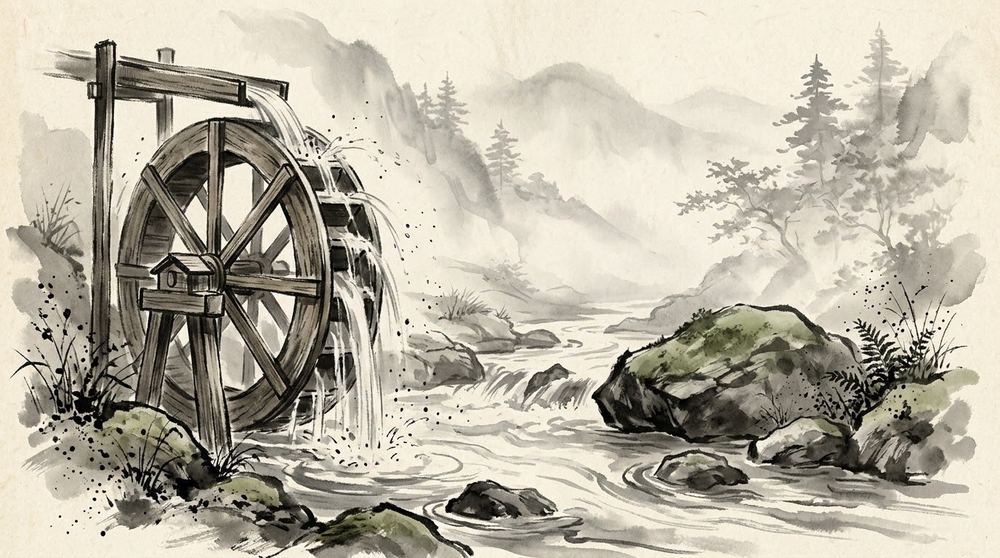
The second image is a wooden cartwheel or waterwheel turning on its axle. A wheel stays upright and useful only because no single spoke insists on remaining at the bottom against the ground. The moment one point of the rim sticks and refuses to move on, the entire wheel jams and skids.
IV. Where Our Modern Minds Get Snagged (午前九時の会議に心を置き忘れない)
We no longer walk through Edo streets carrying a sword at our hip, yet our days are full of moments where our attention snags on a single spoke of the wheel. Think of what happens during a busy morning when a colleague makes a mildly critical comment in a nine o’clock meeting.
For the next four hours, our mind "stops" at nine-fifteen. While we are supposedly writing a report at ten-thirty, eating lunch at noon, or listening to a family member in the evening, nine hundred and ninety-nine of our hands are paralyzed because our awareness is still camped out inside that fifteen-second exchange from the morning. We are not tired because we did too many things that day; we are tired because our mind got stuck on the first thing and dragged it through all the others.
The same snagging happens when we become obsessed with doing something "calmly" or "perfectly." A presenter who is hyper-focused on how their voice sounds on stage has stopped their mind on themselves; they can no longer read the room. A parent who is rigidly determined to follow a script of ideal patience has stopped their mind on the rulebook rather than seeing the actual child standing in front of them.
V. Leaving No Trace Behind the Action
How, then, do we practice Takuan’s fudōshin in an ordinary week? We stop trying to turn ourselves into granite statues, and instead practice not lingering after an action is finished.
In Fudōchi Shinmyōroku, Takuan compares the unfettered mind to striking a flint against steel: the spark flashes the instant the stones meet, without a hair’s breadth of delay, and vanishes the same instant without leaving a smudge on the air. When a task requires your hand—answering a difficult question, correcting an error, carrying a heavy box—give your whole body to that movement. Then, the moment the box is set down on the floor, let your mind let go of the box at the exact same second your fingers do. Do not carry the weight of the ten o’clock meeting into the eleven o’clock walk down the corridor. An immovable mind is not a mind that nothing can touch; it is a mind so supple that nothing can glue it in place.