Zen Koans for Overthinkers: Why the Answer Is Never the Point
A Zen koan for overthinking is not a riddle waiting for a clever solution; it is a deliberate short-circuit designed to exhaust the conceptual mind until discursive thinking falls silent on its own. When we treat every life uncertainty as an equation to solve, our analytical habit turns inward and traps us in recursive loops. By presenting a paradox that logic cannot chew through, a koan shifts our attention from chasing explanations to letting go of thoughts and meeting reality directly.
Late at night, the mind builds courtrooms. You replay a three-sentence conversation from Tuesday afternoon, weighing the pause before a colleague's reply, drafting four possible interpretations, and preparing defenses for each. The room is dark. The ceiling fan turns. Yet inside your skull, a fluorescent office stays lit, filing briefs for a trial that will never take place.
We are taught that if we just think hard enough, we can insure ourselves against regret. So we analyze. We map out contingencies. Still, the knot tightens.
Thinking harder rarely brings peace.
I. The Sound of One Hand and the Gate of "Mu" (隻手的声と、趙州の「無」)
In eighteenth-century Japan, the Rinzai master Hakuin Ekaku watched students arrive at his temple near the foot of Mount Fuji carrying heavy chests of commentary. They could quote sutras from memory and debate Buddhist philosophy until the oil in the paper lanterns burned dry. Yet their shoulders remained tense, and their eyes darted with the same restlessness as merchants counting silver in the marketplace.
Hakuin stopped offering them doctrinal lectures. Instead, he raised a single hand before a student's face and asked: "You know the sound of two hands clapping. Tell me, what is the sound of one hand clapping ?" ( Sekishu no koe ).
Centuries earlier in Tang dynasty China, a monk had approached Master Zhaozhou (Joshu in Japanese) with an equally earnest, binary question: "Does a dog have Buddha-nature, or not?" According to orthodox scripture, the answer was yes—all sentient beings possess it. If Joshu said yes, the monk would file away another neat philosophical concept. If Joshu said no, he would be contradicting the teachings.
Joshu looked at the monk and said simply: "Mu" (無)—literally "nothingness," "not," or "un-ask the question."
A young monk given Joshu's Mu or Hakuin's one hand would return to the meditation hall and do what overthinkers always do: try to figure it out. On the first day, he would bring the master a poetic metaphor. "The sound of one hand is the wind through the cedar branches." The master would ring his small handbell and send him out. On the third day, the monk would try a philosophical abstraction about emptiness. The bell would ring again before he finished his sentence.
Every clever answer was an intellectual trap .
For weeks, the monk would sit with that single syllable— Mu —pressing against his ribs like a warm stone. The intellect would throw every tool it owned at the wall: logic, memory, comparison, irony. Nothing stuck. Slowly, the machinery of binary categorization began to run out of fuel. And in the sudden quiet after the last clever theory collapsed, the monk would hear the rain striking the temple roof—not as a symbol, and not as an argument, just rain on tiles. That unmediated contact, prior to subject and object, is what Zen calls non-dual awareness .
II. When Analysis Reaches Its Edge (理性を捨てるのではなく、理性の「境界線」を知る)
It is easy to misread Zen as an enemy of reason. When we hear stories of masters cutting off debate with a single word, we might assume the tradition asks us to abandon critical thought and drift through the world in passive vagueness.
That is a misunderstanding. Reason is an extraordinary instrument where measurables are concerned. If you are calculating the load-bearing capacity of a wooden bridge, diagnosing a fever, or balancing a household budget, analytical precision keeps you safe. You want an engineer who checks the math twice.
The trouble begins when we apply the bridge-builder's ruler to domains that cannot be measured.
How do you calculate whether you truly forgive your father? What spreadsheet proves that moving to a new city will make your thirties feel meaningful? When can you be one hundred percent certain that someone you love will never leave?
When the analytical mind confronts grief, love, mortality, or an unwritten future, it refuses to admit that its tools do not fit the material. Instead, it doubles its effort. It treats ambiguity as an error in the data. Overthinking is rarely a sign of too much intelligence; more often, it is a category error—using a scalpel to hold water.
A koan does not destroy the intellect. It shows the intellect where the shoreline ends, so we stop trying to row a wooden boat across dry land.
III. Shoshin, Ma, and the Beauty of the Unfinished (初心と、余白のある暮らし)
This willingness to let a question remain open sits at the heart of Japanese aesthetics and contemplative thought. In the Soto Zen tradition, Shunryu Suzuki often spoke of Shoshin (初心)—usually translated as beginner's mind . To a mind proud of its expertise, every situation is a familiar problem with a narrow set of outcomes. To Shoshin , the morning tea in a chipped ceramic bowl is encountered as if for the first time, wide open and unencumbered by yesterday's conclusions.
You see the same sensibility in Ma (間), the interval or negative space in music, architecture, and conversation. In a traditional Noh performance, the most charged moment is not when the actor moves, but the stillness between two steps when nothing happens at all. Without Ma , music is just continuous noise. Without pause, thought is just static.
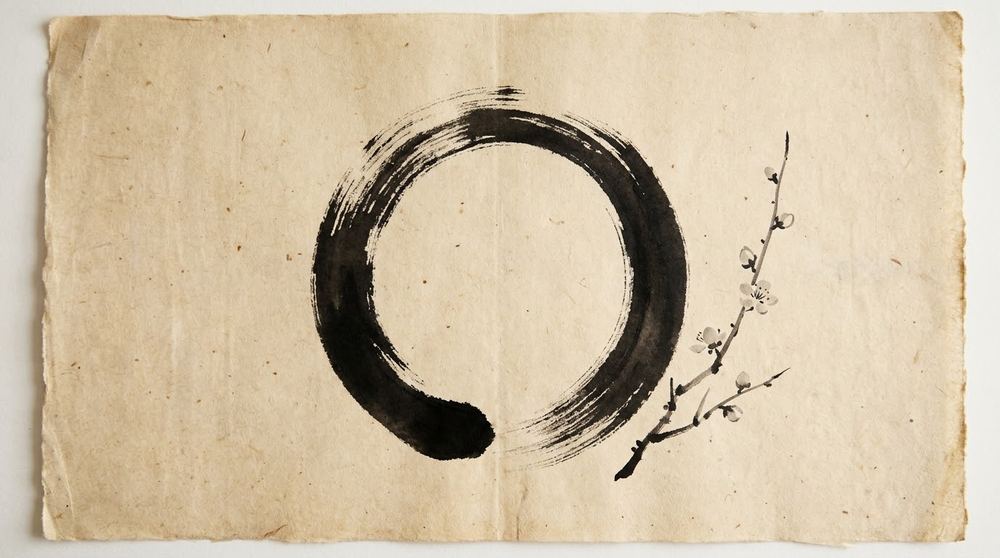
Closely related is Yohaku (余白)—the uninked white paper left untouched in a Sumi-e scroll painting. A painter does not cover every inch of silk to prove their skill. The mist of the mountain is suggested precisely by what the brush leaves alone.
The mind needs white space.
Overthinkers fear Yohaku . When a relationship, a career transition, or a quiet Sunday afternoon contains an uninked corner, we rush in with a fine-tipped pen to fill it with predictions, labels, and worst-case scenarios. The koan teaches us to put the pen down and let the paper breathe.
IV. Practicing the Unanswered Question in Daily Life (日常の中で「問い」と並んで座る)
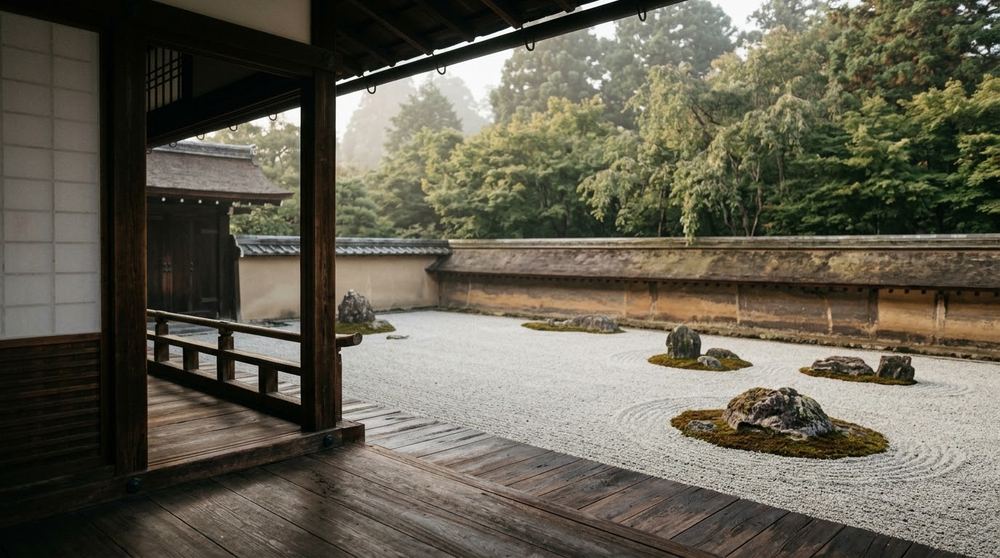
We do not need to enter a monastery in Kyoto to meet our own daily koans. They wait for us at the kitchen sink and in the blue glow of our laptops.
Consider a familiar moment: you have sent an important proposal or a vulnerable message, and six hours have passed without a reply. Immediately, the conceptual mind begins spinning narratives. Did I sound too direct? Are they reconsidering the whole project? Should I send a follow-up right now? Your breath moves into your upper chest. Your jaw tightens while you stand in line for coffee.
Here is how you can work with that moment in the spirit of a koan:
- Name the loop without arguing with it. Notice that your mind is demanding a premature answer to protect you from living with uncertainty . You do not need to scold yourself for worrying; simply recognize that the courtroom has opened again.
- Drop the "why" and touch the physical fact. Discursive thought lives in "what if" and "why." Shift your attention to returning to the present moment through one concrete sensory detail: the weight of your heels on the floorboards, the cool air at the tip of your nostrils, or the warmth of the mug against your palms.
- Hold the question as open space. Instead of forcing a reassuring story ( "Everything will be fine" ) or a catastrophic one ( "I ruined it" ), repeat quietly to yourself: "Not knowing is the most intimate." Let the unanswered state sit there for three slow breaths without rushing to close it.
The email will arrive when it arrives. Your clarity for the next step will be sharper when it is not born from exhaustion.
V. A Quiet Takeaway (静かな持ち帰り)
“A koan does not give you the key to the cage; it gently shows you that the door was built out of your own questions.”
A question to sit with: What question in your life right now are you trying to solve with your head, when it actually only asks to be lived through with your whole presence?