The Mountain of Abandoned Elders (Ubasute): What Japanese Folklore Teaches About Wisdom
At its heart, the Ubasute Japanese folktale meaning centers on the quiet endurance of parental devotion and the irreplaceable value of lived experience. Rooted in an original story from ancient Shinano Province, this enduring folktale reveals how a society that discards intergenerational wisdom in pursuit of mere utility loses the very foundation that sustains it through crisis.
Cold wind scrapes the mountain pines.
In old Japan, scarcity often stripped human choices down to the bone. Yet the stories born from those lean centuries rarely stayed rules about survival. They became mirrors held up to the human heart, asking what a community truly weighs when it measures a person only by the strength left in their hands.
I. The Story: A Trail of Broken Twigs and a Rope of Ashes (月夜の山道と、折られた小枝)
Long ago, in a poor farming province encircled by steep peaks, a harsh decree hung over every household. Once a parent reached the age of seventy and could no longer work the rice paddies, their family was ordered to carry them up to the summit of Ubasuteyama—the Mountain of Abandoned Elders—and leave them to the frost.
A young farmer loved his widowed mother deeply. Her back had curved like a winter bow, and her fingers shook when she lifted her wooden tea bowl, yet her voice remained the calmest sound in his small thatched house. When her seventieth autumn arrived, the farmer wept in secret, bound a woven straw carrier to his shoulders, and lifted her frail body onto his back.
She weighed almost nothing at all.
As dusk settled over the valley, he began the slow climb. The path grew narrower with every turn, tangled in cedar roots and shadowed by overhanging branches. A pale autumn moon rose above the ridge. Through the heavy silence, the son heard a soft, regular sound behind his ear.
Snap.
Then, a few paces later, another.
Snap.
Looking back over his shoulder, he saw his mother reaching out with her thin, weathered hand to grasp the dry pine twigs brushing against them, breaking each one and letting it fall onto the dark soil.
"Mother," he whispered, his voice catching in the cold air. "Why are you breaking the branches?"
Her cheek rested lightly against his rough cotton coat. "The mountain path is dark and winding, my son," she replied softly. "When you walk back down alone tonight, I do not want you to lose your way."
The son stopped in his tracks.
He looked down at the pale line of broken twigs glinting faintly in the moonlight. He was carrying her to her death, and her only thought was his safe return home. Falling to his knees on the cold stones, he wrapped his arms around her legs and sobbed. He turned back down the mountain, following the very twigs she had dropped, and carried her home before dawn.
Beneath the wooden floorboards of his kitchen, he dug a hidden chamber. There, in the quiet dark, he brought her warm bowls of millet, fresh water, and clean quilts, keeping her presence a secret from the village eyes.
Two winters passed. Then, a neighboring warlord threatened to conquer the province unless its ruler could solve an impossible riddle: present a coiled rope made entirely of ashes.
The ruler summoned his wisest magistrates, yet every attempt failed. Whenever they burned a braided straw rope, the fibers crumbled into a formless heap at the slightest breeze. Facing ruin, the ruler offered a great reward to anyone in the province who could produce the impossible object.
That night, the farmer knelt by the floorboards and told his mother of the decree. She listened in silence, her eyes half-closed in the dim lamplight.
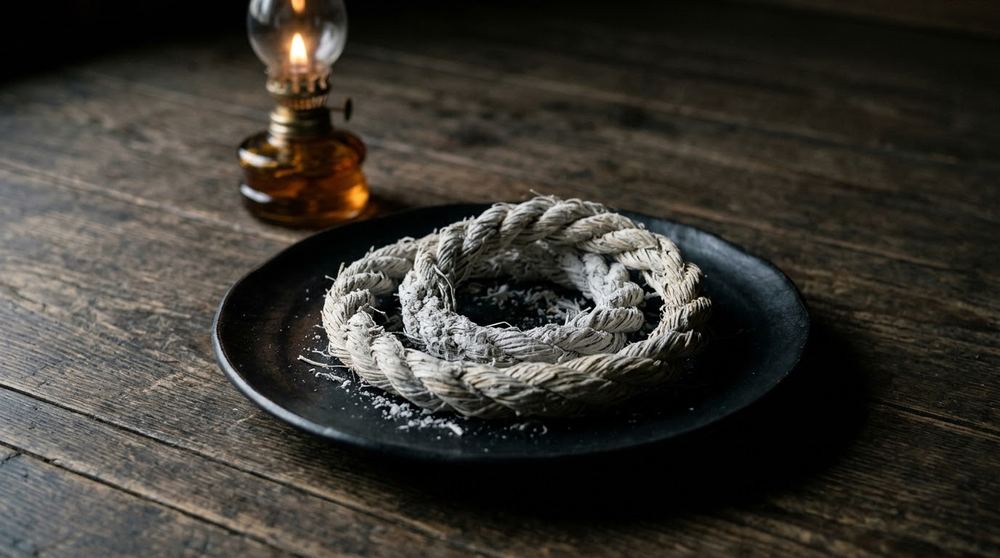
"Take a tightly twisted rope of rice straw," she said quietly. "Soak it overnight in a basin of thick salt water, then let it dry completely in the sun. Place it coiled upon a flat clay dish and burn it where no draft can reach."
The farmer followed her words to the letter. When the last ember faded on the black ceramic plate, a pale gray coil remained—every twisted strand intact, a perfect rope of ash. That is the core rope of ashes folktale moral lesson: what seems impossible to youthful urgency often yields to patient, seasoned observation. When the lord learned where the farmer had found the answer, he was struck with shame. Seeing the quiet symbolism of the fragile yet unbroken ash, he abolished the cruel law forever, honoring the truth at the heart of Japanese folklore about elders wisdom .
II. Meaning & Nuance: Fire, Ash, and the Architecture of Memory (懐古ではなく、構造としての知恵)
It is easy to read an ancient tale like Ubasute as a simple moral fable about respecting the old. Yet if we look closer at the image of the burned rope, a subtler tension emerges.
Valuing the wisdom of elders does not mean clinging blindly to the past or refusing to let new fires burn. A society that worships yesterday without question stagnates just as surely as one that erases its memory. Youth brings heat, movement, and the courage to ignite change. Fire is necessary.
Still, fire alone leaves nothing to build upon unless something holds the form together.
In the story, the salt absorbed deep within the straw fibers is invisible before the flame touches it. Only after the heat passes does that hidden mineral strength keep the braided structure from collapsing into dust. Lived experience works in much the same way. Older generations may no longer carry the physical speed or technical fluency of the young, yet decades of weathered seasons leave a quiet salt in the grain of their judgment—an understanding of human nature, grief, cyclical crisis, and restraint that cannot be improvised in an afternoon.
Ash remembers the rope's true shape.
When we dismiss what came before us as obsolete simply because its outward strength has faded, we mistake the flame for the whole substance of life. True maturity lies in recognizing that progress and memory are not enemies; the new flame needs the old fiber to leave a lasting form.
III. Japanese Thought: Onkochishin, Kōkō, and the Space Between (温故知新、孝行、そして「間」)
Three classical threads of Japanese thought run quietly beneath the surface of Ubasuteyama.
The first is Onkochishin (温故知新)—often translated as "cherishing the old to understand the new." Notice that the first character, On (温), does not mean merely studying or archiving the past in a cold museum case; it carries the warmth of keeping something alive in the palms of one's hands. The farmer does not treat his mother as a relic. He warms her beneath the very floor where he cooks his daily meals, and from that living warmth comes the insight that saves the province.
The second is Kōkō (孝行), filial devotion. In the Ubasute narrative, Kōkō is not a rigid, joyless obligation imposed by state law—in fact, the state law demands the exact opposite. Instead, filial devotion is born in the moment the son notices the broken twigs on the dirt path. It is an awakening of reciprocity: the sudden, humbling realization of how long we were carried before we ever learned to walk on our own.
The third is Ma (間)—the intentional pause or negative space between actions. When the warlord's riddle throws the court into panic, everyone rushes to burn ropes in haste. Beneath the floorboards, the mother exists in a space removed from the frantic noise of the village. Her answer emerges from stillness.
Wisdom requires room to breathe.
IV. In Daily Life: Practicing Quiet Reciprocity (耳を澄ますということ)
Practicing Onkochishin philosophy in daily life rarely requires grand gestures. More often, it asks us to notice where we have quietly built our own smaller versions of Ubasuteyama—the subtle ways we push slower voices, older craft, or long-tested principles to the margins because they do not move at the tempo of our immediate ambitions.
Consider a familiar moment at work or within a family. A complex disagreement arises, and the instinct is to reach immediately for a brand-new framework, a faster tool, or a sweeping reorganization, while overlooking the quiet colleague or aging relative who has watched three similar storms gather and pass over forty years.
To bring patience and perspective back into our ordinary days, we can practice three small habits of attention:
- Ask for the salt, not just the speed: When facing a stubborn problem, seek out someone whose season of active striving has passed. Ask them not what tool to use, but what human pattern they recognize beneath the surface.
- Look for the broken twigs: In moments of tension with aging parents or mentors, pause before reacting to their slowness or repetition. Look for the quiet, unspoken ways their care is still trying to mark a safe path for you.
- Keep a space beneath the floor: Set aside ten minutes in the evening with no screens, no urgent metrics, and no rush to produce. Sit with an old book, a handwritten letter, or a memory that grounds you in humility and gratitude .
We walk on paths others cleared.
V. A Quiet Takeaway
“The flame belongs to the young, but the salt that keeps the ash from scattering belongs to the years.”
Reflection Question: Whose quiet experience or unspoken care has marked the path beneath your feet—and how might you pause to listen to them this week?