The story English readers know as “The Stonecutter” arrives with a passport that has been stamped more often than most tales admit. Andrew Lang printed it in The Crimson Fairy Book in 1903 and labelled it Japanese, saying he had taken it from David Brauns’s Japanische Märchen und Sagen, published in Leipzig in 1885. But forty years before Lang, a Dutch novel had already told nearly the same story: in Max Havelaar (1860), Multatuli gives the parable of the Japanese stonecutter who wishes himself up the ladder of creation. And Multatuli’s version follows a piece published in 1842 by Wolter Robert van Hoëvell under the pen name Jeronimus. In 1875, Charles Wycliffe Goodwin went looking for a Japanese text behind it, found none in print, and noted that the tale was nonetheless being told orally in Japan. Japanese reference works, for their part, have long called the story European, and some give the stonecutter a very un-Japanese name: Hans.
None of that ruins the story. It tells you what kind of thing the story is. This is a tale that has been carried across languages the way a good pot is carried across a courtyard — handled by many hands, and made more useful by the handling. Its plot is one of the most durable in the world: the Aarne-Thompson index files it near type 555, the same family as the Grimms’ The Fisherman and His Wife, where wishing upward ends with an empty hut and a flounder who has stopped answering. What changes in each country is the furniture. What stays is the ladder.
I. A Spirit, a Gravestone, and Six Rungs
In Lang’s telling, a spirit lives in the mountain and now and then helps people become rich and prosperous. A stonecutter carries a gravestone to a rich man’s house and sees silk, tassels, and a bed he will never sleep in. He wishes aloud that he were a rich man. A voice answers: Your wish is heard; a rich man you shall be.
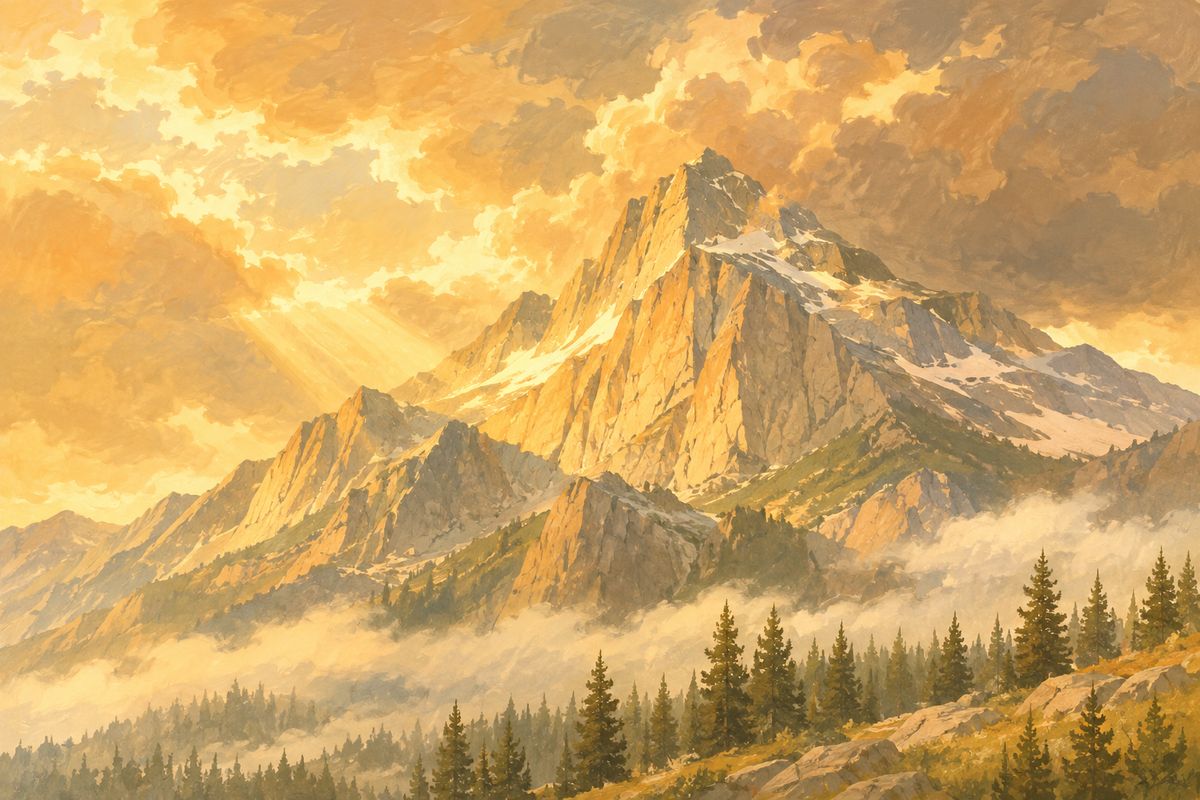
Then the heat comes. He wishes to be a prince, and is one. Then the sun burns too fiercely, and he wishes to be the sun — granted. A cloud crosses the sun and darkens the earth, so he wishes to be the cloud — granted. The cloud pours rain until the valleys flood, and one thing stands unmoved: the great rock on the mountainside. He wishes to be the rock — granted, and he is a mountain, taller than prince, sun and cloud.
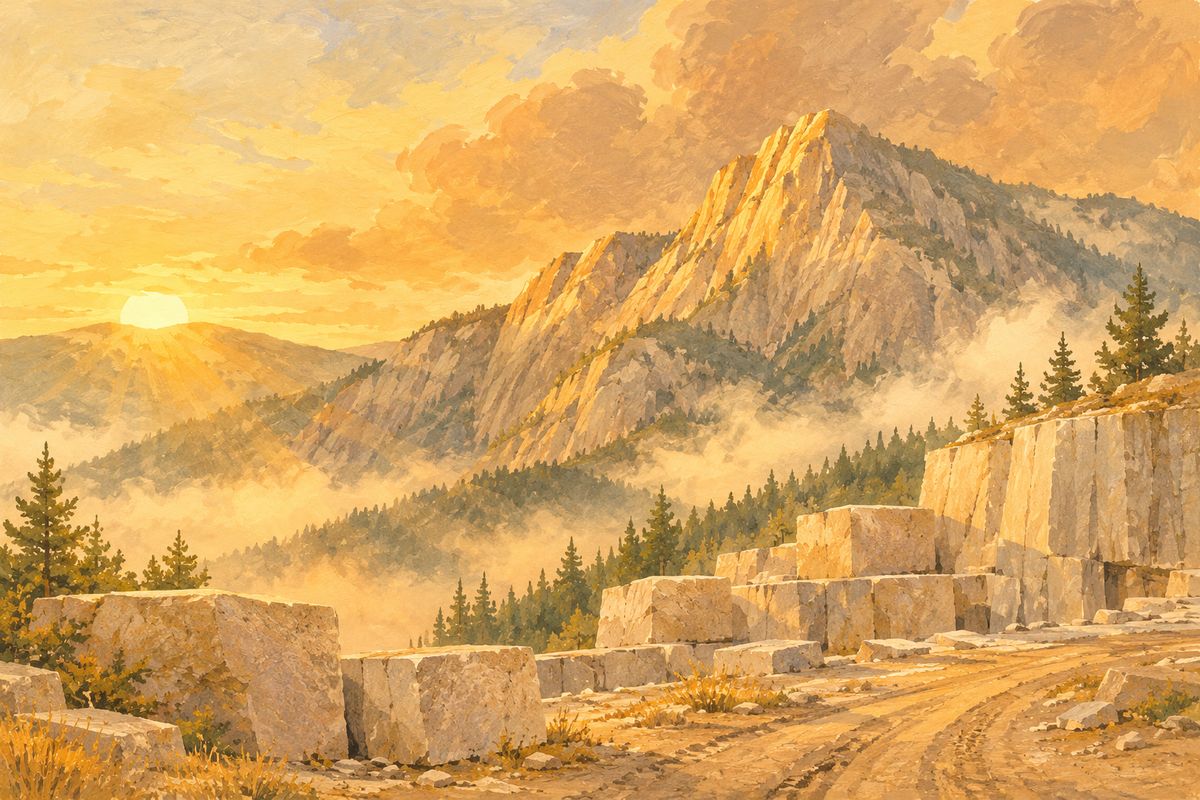
Then, one morning, something taps at his base. A stonecutter — small, poor, ordinary — is driving a chisel into his foot and splitting off a slab. The rock, which no rain could move, is being taken apart by a hand. And the last wish in the story is the smallest one: Oh, if I were only a man! The voice answers, and he is a man again.
Notice how the ladder is built. Every rung is chosen by looking at what defeated the previous rung. The sun beats the prince; the cloud beats the sun; the rock beats the cloud; the chisel beats the rock. Envy has a grammar, and this is it: it can only ever name the next thing up. It never reaches a last step, because there is always one more thing that can be beaten by something else. The ladder does not lead to a summit. It leads sideways, forever.
II. The Chisel at the Foot of the Mountain
The ending is easy to misread as a moral about humility: be satisfied with your lot. But look at what actually breaks the spell. It is not a god, a punishment, or a sudden insight. It is work — the specific, repetitive, unglamorous work the stonecutter used to do, still going on somewhere below him without any need for his permission.
That is a sharper observation than “be content”. The mountain is not defeated by something greater. It is defeated by the thing he walked away from. The craft he was ashamed of turns out to be the only force in the story that nothing above it can answer: not silk, not sunlight, not weather. He does not return to the quarry because he has learned to accept his station. He returns because he has finally seen the whole ladder at once, and the top of it is a slab of granite being cut by somebody else.
And Lang’s ending is careful about the size of the reward. The stonecutter does not come back as a master, a rich man, or a prince with better manners. He comes back as himself, with the same cottage and the same mallet. Nothing is added. What is removed is the wishing.
III. What the Retellings Add
Almost every detail readers remember from modern versions is not in Lang. There is no “Taku”; the stonecutter is never named. He does not shape stepping stones for garden paths or lanterns for shrines — he carries a gravestone. There is no golden silk parasol and no three days of rejoicing. And the voice is not a personal whisper in his ear: it is a spirit that lives in the mountain and answers wishes generally, the way weather answers a hillside.
The invented details are not crimes; a story has to be furnished to be told to children. But they shift the meaning. A named hero with a cottage and a routine is a man with an identity to lose. An unnamed stonecutter who simply wishes is closer to what the story is about: not a personality, but a posture — the habit of measuring your life against the rung above you, whoever is standing on it today.
The Rung You Are Standing On
In daily life the ladder rarely looks like a ladder. It looks like a phone screen at eleven at night, or a conversation at a family table about someone’s new apartment, or the particular tiredness of hearing that a colleague closed something you did not. The wish is never phrased as a wish. It is phrased as an observation: they have it easier.
One honest move: when you notice the climb starting, name the rung out loud, even if only to yourself — right now I want to be the cloud. Naming it does not remove it, but it converts a mood into a sentence, and a sentence can be examined. Then ask the boring question the story insists on: what does that thing actually do all day? The prince sits under a parasol and sweats. The sun is blocked by the first cloud. The mountain is slowly cut by a chisel.
Then put your hand back on the tool that is already in it. This is not a metaphor for settling. It is the practical claim the tale makes: the only power in the story that nothing could beat was a craft, and the craft was the one thing he had owned from the beginning — before the first wish, and after the last one.
A Practice for This Week
Choose one person whose life you have been quietly measuring yours against. Not to shame yourself — just to look. Then write down two things: the specific thing you envy, and the specific work that person does that you would not want to do on a wet Monday. The second list is usually longer than expected, and it is the list that dissolves the wish.
Then go and do twenty minutes of your own craft, the unglamorous part, the part nobody photographs. The story does not promise that the mountain will move for you. It promises something smaller and more usable: that the tapping at the foot of the mountain is not an insult. It is the sound of a life being made by hand.