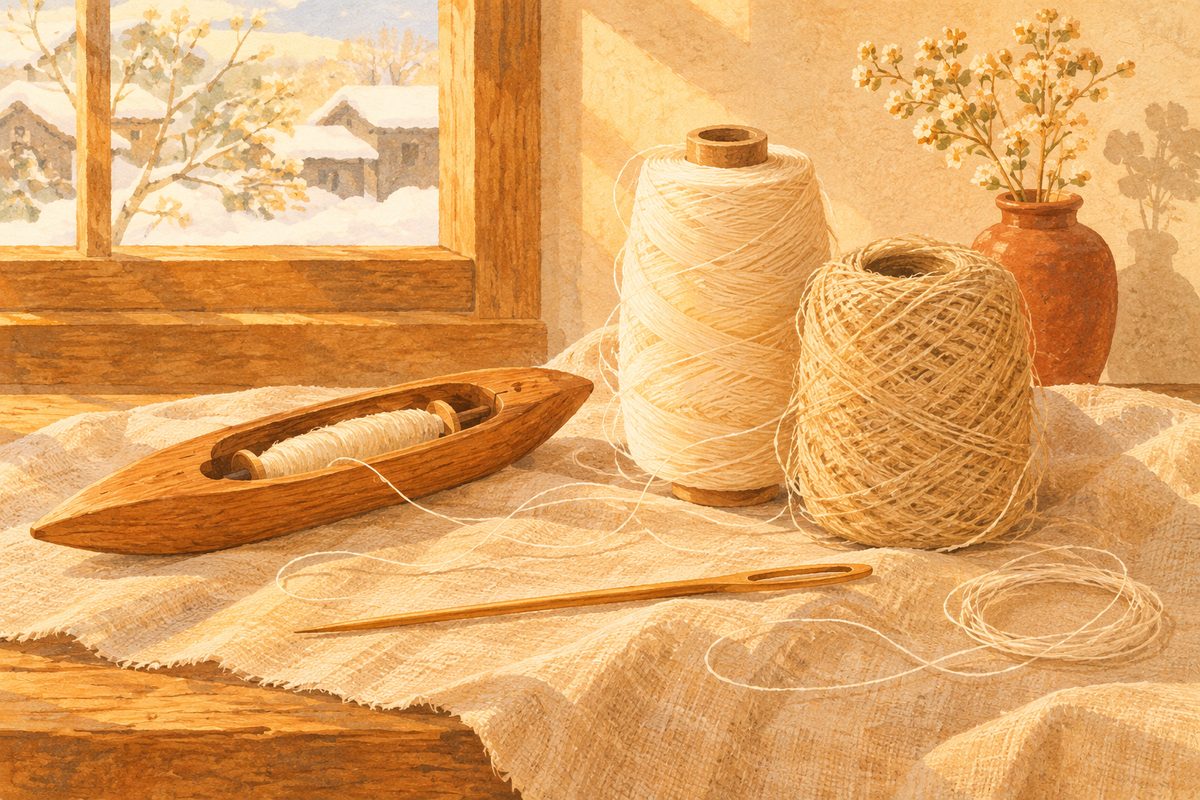
In the snow country of Niigata and Nagano, where winter drifts rise to the second-story eaves, generations of women spent the long quiet months from December to March seated at wooden handlooms (機織り機, Hataoriki). In the weaving sheds of this region, hands worked with fine raw silk and hand-spun hemp threads that were thinner than a strand of hair.
Whenever a young apprentice joined the shed, the same crisis inevitably occurred during the second week. While passing the wooden shuttle too quickly between the warp threads, two delicate silk strands would catch and tangle into a tiny, stubborn snarl.
I. Loosening Tension Before Untying the Knot (まず力を抜いてから結び目をほどく知恵)
Anxious to prove their speed and embarrassed by the delay, the apprentice would instinctively pinch the silk and pull sharply with both hands. Of course, the harder they tugged in frustration, the tighter the microscopic fibers locked together—until the silk snapped with a soft ping, ruining hours of careful pattern alignment.
“A knot tightened by impatience can never be conquered by force; it yields only when you first give the thread slack and breathe warmth onto your fingers.”
Whenever the rhythm of a shuttle stopped abruptly, a seasoned weaver would walk over without a word of scolding, place her warm, wrinkled palm gently over the apprentice’s tense wrist, and whisper: "First, let go of the shuttle. Lower your shoulders. Give the thread slack so air can enter the center of the knot."
II. Untangling Human Misunderstandings Without Snapping the Bond (人間関係の絡まりをほどく技術)
With a bamboo needle and unhurried fingers, the weaver would gently coax the outer loop of silk outward—creating space rather than tension—until the knot slipped open of its own accord, leaving the thread unbroken and ready for the loom once more.
How closely human relationships resemble fine silk on a winter loom! When a misunderstanding arises between spouses, between parent and teenager, or between lifelong friends, our impatient ego immediately wants to yank the thread straight: to win the argument tonight, to force an apology, or to prove we were right. Yet force applied to a bruised heart only cinches the knot tighter until trust snaps.
III. Why Winter Patience Produces the Strongest Linen (雪国の冬が教えてくれる「急がない手仕事」)
In Niigata’s Ojiya and Uonuma regions, the finest ramie cloth (越後上布, Echigo-jōfu) can only be woven during humid winter days when snow blankets the fields outside, because dry summer air makes the delicate plant fibers brittle. Our own hearts also have seasons when forced speed will only snap the thread; learning to respect the humidity and rhythm of the room is the mark of a true elder.
Giving Slack to Today’s Tangled Moment (心の糸が絡まったときの「緩める」実践)
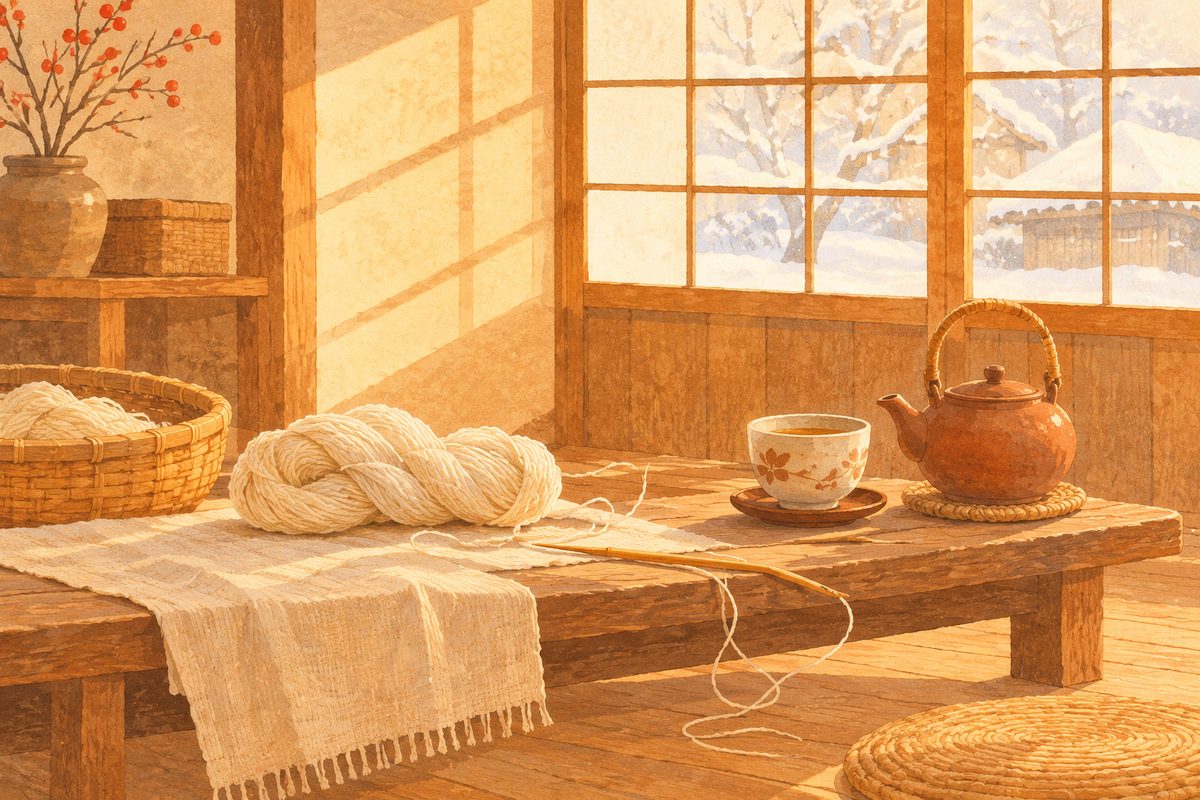
When a conversation or a complex task tangles today, resist the urge to pull harder for ten quiet minutes. Step back from the loom, brew a pot of warm roasted tea, and ask yourself gently: "How can I reduce the tension in this room before we try to solve the problem?" Once gentleness creates breathing room, the path to untying the knot will appear naturally without breaking a single precious thread of family or friendship trust.