This story is Chinese, not Japanese, and it is older than most of the proverbs we keep in the kitchen drawer. It sits in the Huainanzi (淮南子), the compendium compiled under Liu An (劉安) in the second century BC, in the chapter called Renjian Xun (人間訓), the teachings of the human world. Japan took it in through Chinese letters and turned it into a sentence people still say at funerals, at hospital beds, and at the wrong end of a bad week: Ningen banji saiō ga uma (人間万事塞翁が馬) — all human affairs are the horse of the old man at the pass.
The man at the centre of it is often retold as a farmer. The text itself is more exact and more interesting. It calls him saiō (塞翁), the old man of the frontier pass, and says only that he was zenjutsusha — a man skilled in the arts of reading fortune. He owns a horse. That is the whole of his introduction.
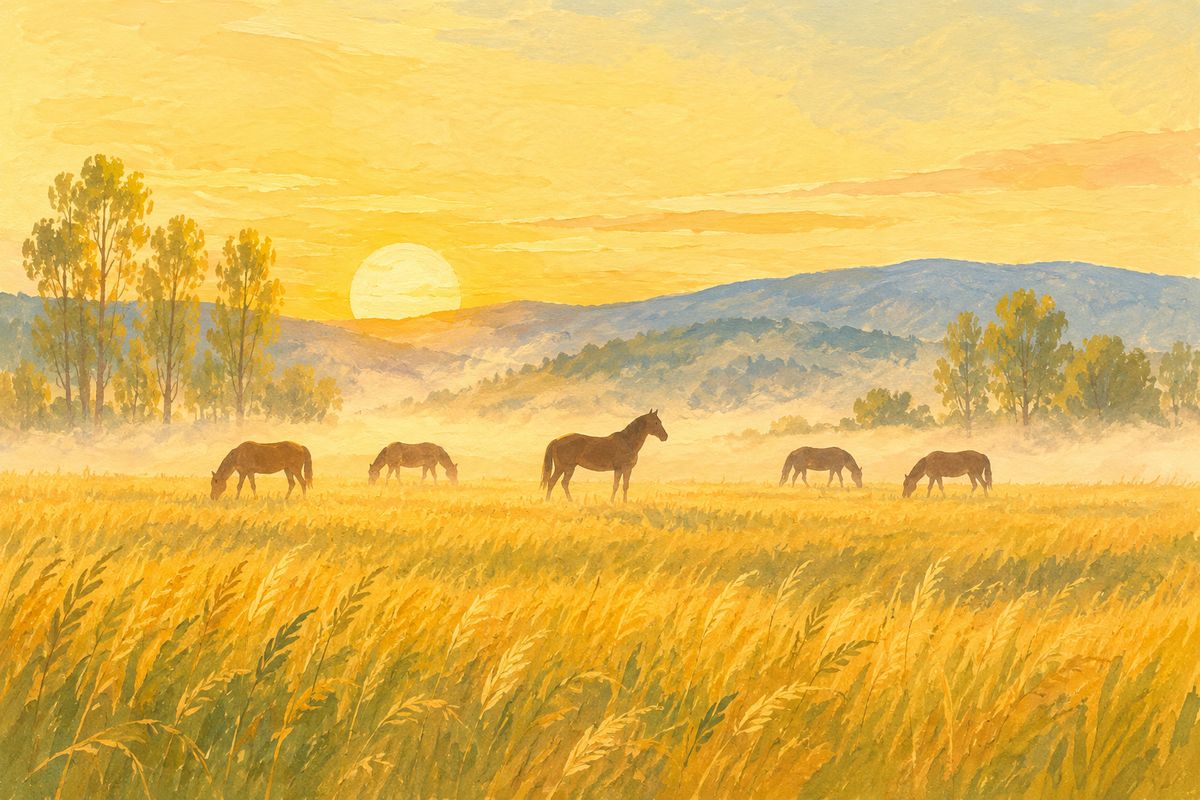
Then one day the horse wanders off north into Hu (胡), the land of the northern peoples. No reason is given. A gate is left open, a rope is loose, or the animal simply decides; the Huainanzi does not care. What it cares about is what happens next in the courtyard, among the neighbours.
I. 此何遽不為福乎 — How Do You Know This Is Not a Blessing?
They come to console him. He answers with a question, and the text repeats that question almost word for word at every turn of the story: 此何遽不為福乎 — how could you be so sure this is not a blessing?
Months pass (居數月). The horse comes back, and it does not come back alone: it arrives leading fine horses of the north (将胡駿馬而歸). The courtyard fills with neighbours again, this time to congratulate him. The same question, turned on its head: 此何遽不能為禍乎 — how could you be so sure this is not a misfortune?
He has a son who loves to ride (其子好騎). One day the boy falls from a horse and breaks his thigh (堕而折其髀). The neighbours lament; the old man asks his question again. A year later (居一年) the Hu cross the pass in force. Every able-bodied man in the district is called to the bow (丁壯者引弦而戰), and of the men of that frontier, nine in ten die (死者十九). The son is lame, so he is left at home, and father and son keep each other alive (父子相保).
The chapter does not end with a cheerful slogan. It ends with a limit: 故福之為禍、禍之為福、化不可極、深不可測也 — blessing becomes misfortune, misfortune becomes blessing; the transformations have no end, and their depth cannot be measured. That is a stranger sentence than the proverb made from it. The proverb sounds like reassurance. The original sounds like a warning about the confidence with which we label things.
II. The Chorus in the Courtyard, and the One in Our Heads
The neighbours are not fools and they are not villains. They are doing what people do: they read the first page and call it the plot. A contract falls through and the house is already sold in their imagination; a stranger calls and the whole year is already ruined; a good month arrives and they start planning around luck that has not finished arriving.
What the story notices is not that the neighbours are wrong about outcomes. Sometimes the horse stays gone. Sometimes the broken thigh never pays for itself in any visible way. What the story notices is that they pronounce a verdict while the page is still being written — and that the pronouncing costs them something every single time, whether or not the outcome later proves them right or wrong.
The Huainanzi has a word for the thing they keep interrupting: ka (化), transformation. Its point is not that everything turns out well. Its point is that the turning has no end, so no single moment is a fair place to stand and grade a life.
III. 平常心是道 — The Later Name for an Older Posture
About seven hundred years after the Huainanzi, a Chan master named Nanquan Puyuan (南泉普願, 748–835) was asked by his student Zhaozhou: what is the Way? He answered: heijōshin kore dō (平常心是道) — ordinary mind is the Way. Zhaozhou pushed: can one aim at it? "If you aim at it," Nanquan said, "you turn away from it." The exchange is preserved as case nineteen of the Mumonkan (無門関), compiled in 1228.
The old man of the pass is not a Zen figure, and the Huainanzi is not a Buddhist book; the phrase is a later lens, not a source. But the postures rhyme. Both refuse the dramatic gesture. Both treat the ordinary day — tea, horse, field, son — as the only place where anything can actually be met. Neither one says the storm will pass. They say: do not decide yet.
This matters because the alternative is exhausting. To live as the chorus is to be permanently employed as a judge of events that are still in progress, sentencing a Tuesday, then appealing it on Thursday, then sentencing it again. The old man's question is cheaper. It is also, as far as anyone can tell, more accurate.
What the Story Does Not Say
Three details get added in retellings, and none of them are in the text. The horse is not described as a prize mare — it is simply his horse. The animal does not return with four or five stallions: the text says 胡駿馬, fine horses of the north, no number. And the son does not break his thigh taming a wild colt; he falls while riding, because he loves riding. The old man is not a destitute peasant either. Later in the same passage the text says 家富良馬 — the household grew rich in good horses.
These are small corrections, but they change the shape of the lesson. This is not a story about a poor man rewarded for patience. It is a story about a man who refuses to grade events too early, and who is right three times in a row — inside a chapter that immediately reminds us the transformations cannot be measured. The story does not promise that your horse comes back. It only removes your licence to announce, at noon, what the day was.
A Practice for This Week
When something lands — a yes, a no, a silence that could be either — try saying the old man's sentence in the language you think in: I don't know yet. Not as optimism. Optimism is a verdict too, just a pleasanter one. Say it as a statement of fact: the page is not finished.
Then do the next ordinary thing. Feed what needs feeding, answer what needs answering, and let the year do the part of the work that only a year can do. The man at the pass was not calm because he knew how things would end. He was calm because he had stopped pretending that he did.