In the old farmhouses of the Japanese countryside, the sunken hearth (囲炉裏, irori) was the one place in the house where the fire never quite went out, and winter evenings were spent inside its small circle of light. That is where stories were told — not read aloud from a book, but handed over slowly, one voice to the next. Among the tales that travelled that way was one about a tree that refused to bend.
The story is older than Japan. It is Aesop's fable of the Oak and the Reed, numbered 70 in the Perry Index of Aesopic fables. In its oldest Greek prose form the oak and the reed argue about strength as equals, and the moral is a cautious one: do not contend with what is stronger than you. When Jean de La Fontaine retold it in 1668 as Le Chêne et le Roseau (Fables I.22), he gave the oak a generous speech offering the reed its protection — and gave the reed the line the fable is remembered for: I bend, but I do not break. La Fontaine then dropped the moral and let the storm speak for itself.
The fable did not need translating to feel Japanese. The language already had two proverbs standing in the same place: 柳に風 — willow in the wind, meaning to yield without resisting — and 柳に雪折れなし, "a willow never breaks under snow," which the dictionaries gloss as the lesson that what is supple outlasts what is rigid. A grove of bamboo, which bends almost flat and comes up the next morning, made the same point in a form anyone who has lived near one can see with their own eyes.
I. Why a Hollow Stem Does Not Snap in the Gale (中空の竹が暴風でも折れない理由)
In the fable, the oak looks down at the reed and cannot hide its contempt. The slightest breeze, it says, makes you bow your heads to the water, while I stand firm. The reed does not argue. It bows, and it keeps its roots where they are.
Then the storm comes. The oak holds its ground against the whole weight of the wind, and because it will not give an inch anywhere, the strain gathers in the one place it cannot be released — the trunk. It goes over. The reeds, which have been practising the same small movement all season, are still standing when the sky clears.
Bending is not the same as surrender. The reed gives way at the top so that it can keep its hold at the bottom.
The distinction matters because it is easy to mistake one for the other. A person who bends in an argument, who lets a plan change without treating the change as a defeat, is not spineless; they are keeping their roots. What breaks people is usually not the size of the wind but the refusal to let any part of themselves move with it.
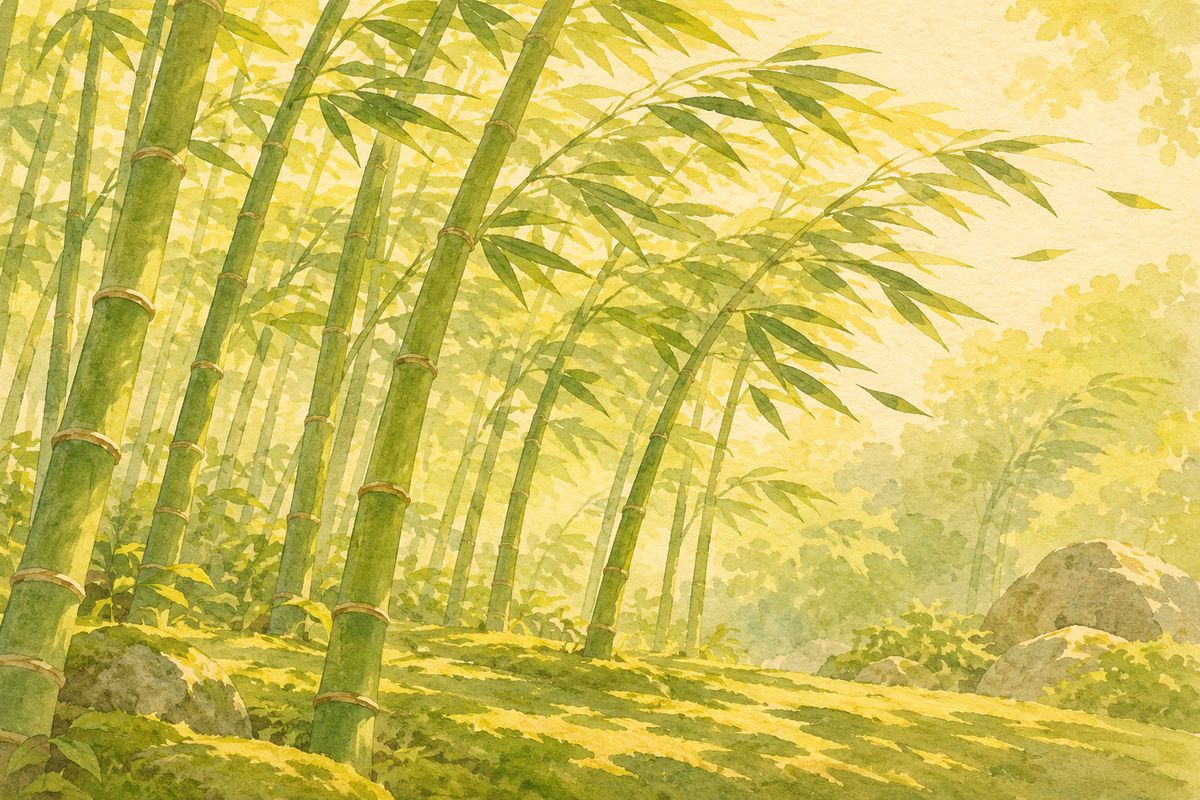
II. The Three Secrets of the Bamboo Grove (竹が持つ三つの強さの秘密)
The villagers who told this story by the hearth had no botany, but they had spent their lives among the plants, and they noticed three things worth keeping.
The first is that the bamboo stem is hollow (中空, chūkū). Nothing in the middle means nothing to defend: no core of self-importance that has to be protected when circumstances change. An oak's strength is concentrated, and so is its weak point. Bamboo's is distributed, and so it survives being wrong.
The second is the node (節, fushi). A bamboo culm is not one smooth tube; it is a series of segments, each sealed by a ring of harder fibre. The plant grows a new node after each push upward. Anyone who has come through a hard year knows the feeling — the place where you stopped, took stock, and started again is tougher than the part that was never tested.
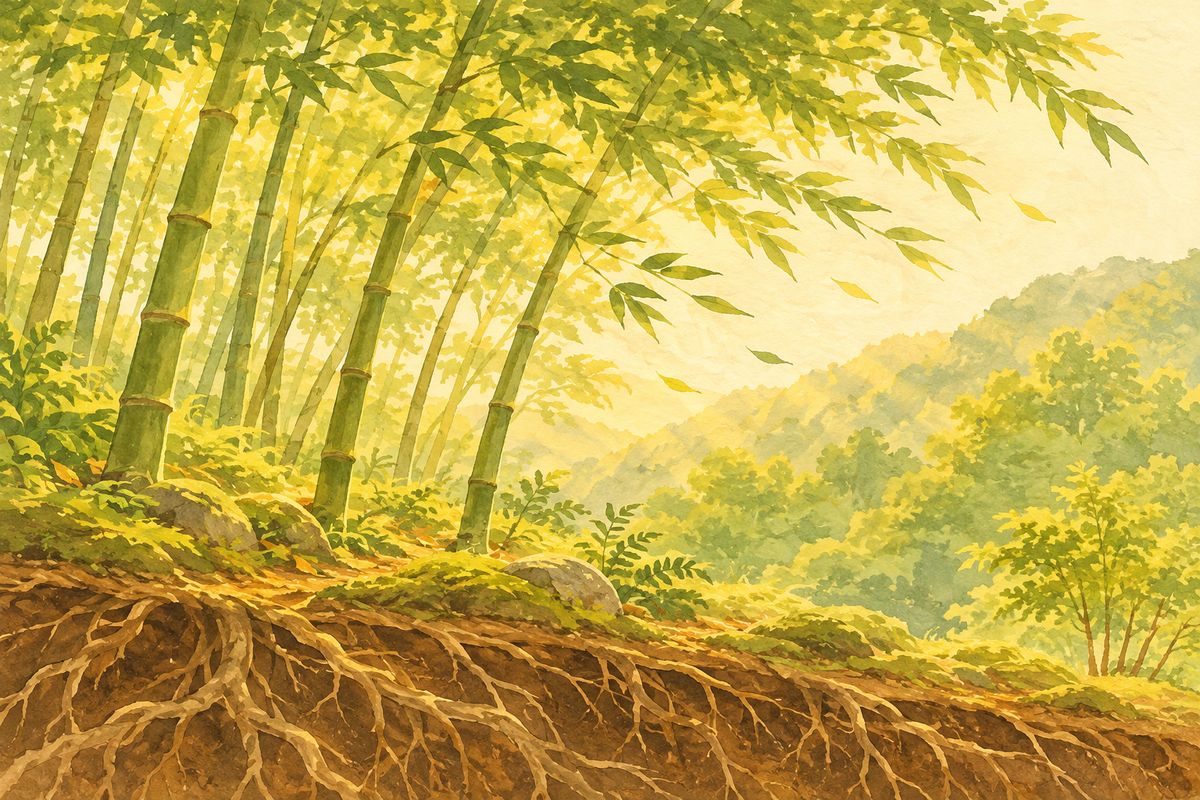
The third, and the one most worth carrying out of the story, is the rhizome (地下茎, chikakei). What you see above ground is not the whole plant. Moso bamboo (孟宗竹, mōsōchiku) — the tall timber bamboo whose shoots are the fat spring takenoko sold in every Japanese market — spreads through a network of underground stems that puts up new culms year after year. The name itself is a piece of lore: it honours Meng Zong, the third-century Chinese official counted among the Twenty-Four Paragons of Filial Piety, whose mother longed for bamboo shoots in the snow and who is said to have been given them by a thaw. A grove that looks like many separate stalks may in fact be one connected organism, sharing what it has.
It is worth being careful here, because this is where the metaphor is often pushed further than the botany will carry it. Rhizomes genuinely connect culms and let a grove regrow after being cut; they do not perform an engineering calculation and distribute wind load. The truth is better than the exaggeration: the part of the plant that keeps it alive is the part nobody photographs.
III. Building Invisible Roots Before the Typhoon Season Arrives (嵐が来る前に地下茎を育てる)
Notice the timing. The bamboo does not begin weaving its underground network on the night of the typhoon. It has been doing it, quietly, in ordinary weather, for years.
Most of the resilience in a human life is built the same way and in the same unglamorous conditions: a neighbour you actually know by name, a promise kept when it cost you something, a habit of admitting you were wrong while it is still cheap to do so. None of that shows up in a photograph. All of it is what you will be standing on when the wind arrives.
Practicing Flexible Strength Under Pressure (試練の日に思い出したい竹の呼吸)
The next time hard news or harsh criticism lands in your week, check the body first. Is your jaw set? Are your shoulders up around your ears? That is the oak bracing. Exhale longer than you inhaled. Bow slightly to the fact of the moment — not to the other person's opinion of you, but to the fact — and then go and tell one person in your network what actually happened. 柳に風: let the wind pass over you, and keep your roots.